Start with what you are actually noticing.
| What you are noticing | This usually points to | Where to start |
|---|---|---|
| Blurred distance vision, or a rising glasses number | Refractive (your glasses power) | Specs removal |
| Cloudy, faded vision with heavy headlight glare, usually after 50 | Cataract (motiyabind / safed motia) | Cataract Surgery |
| Gradual loss of side vision, or kala motia in the family | Glaucoma (kala motia) | Glaucoma Treatment |
| New floaters, flashes, a curtain across your vision — or diabetes | Retina | Retina Services |
| Pain, redness, watering, a scratched or hazy cornea, keratoconus | Cornea | Cornea Services |
| A droopy eyelid, a watering eye, a lid lump, thyroid eye changes | Oculoplasty | Oculoplasty |
| A child screwing up their eyes, sitting close to the screen, one eye turning in | Paediatric & squint (bhengapan) | Paediatric & Squint |
These symptoms overlap. Glare can come from a cataract or a dry cornea; blurring can be a glasses number, a retina problem, or — in diabetes — both. A comprehensive eye examination is what sorts it out, which is why we start every patient there.
Refractive treatment corrects your glasses power — nearsightedness (myopia), farsightedness (hyperopia) and astigmatism — by reshaping the cornea or placing a lens inside the eye. It is for adults with a stable number who want to depend less on spectacles and contact lenses.
We offer LASIK, ReLEx SMILE on the ZEISS VisuMax, Contoura Vision on the Alcon WaveLight EX500, PRK and Epi-Contoura, ICL (phakic IOL) for higher powers or thinner corneas, and Ortho-K lenses for a non-surgical route.
Led by Dr. Sanjeev Bisla, our Director and Chief Ophthalmologist, with 23 years in practice. Not everyone is a candidate: suitability depends on corneal thickness, shape, power stability and overall eye health — and we will tell you plainly if you are not.
A cataract (motiyabind or safed motia) is the natural lens inside your eye turning cloudy with age. Vision fades, headlight glare becomes hard to manage, and reading gets harder even with the right glasses. Treatment removes that lens and replaces it with an artificial intraocular lens (IOL).
We perform phacoemulsification and MICS (micro-incision cataract surgery), and FLACS — femto-laser-assisted cataract surgery. Lens choice is discussed with you rather than decided for you: monofocal, multifocal, toric for astigmatism and accommodating IOLs suit different eyes, different work and different budgets.
Led by Dr. Sanjeev Bisla, who has personally performed over 80,000 cataract surgeries, with Dr. Hem Shah also operating across phaco and femto techniques.
Glaucoma (kala motia) damages the optic nerve, usually because pressure inside the eye is higher than that nerve can tolerate. It takes side vision first, and quietly, so it is often found on a routine examination. Vision already lost cannot be recovered, so treatment protects what you still have.
We manage it with pressure-lowering drops, laser treatment, trabeculectomy, and drainage implants for eyes that need more. Monitoring matters as much as the procedure: we track visual fields on the ZEISS Humphrey Field Analyzer and the optic nerve on RTVue FD-OCT, so change is caught between visits.
Shared by Dr. Sanjeev Bisla, who holds a glaucoma fellowship from Aravind Eye Hospital, and Dr. Digvijay Singh, who trained 12 years at AIIMS New Delhi and developed glaucoma screening tools used internationally.
The retina is the light-sensitive layer at the back of the eye. Problems here usually show up as new floaters, flashes of light, a shadow across your field, or a slow central blur. If you live with diabetes, your retina needs checking whether or not you have symptoms.
We treat diabetic retinopathy (diabetes-related eye damage), age-related macular degeneration (AMD), retinal detachment and other vitreo-retinal conditions — with laser, intravitreal injections, or vitrectomy surgery in our dedicated retina theatre. Imaging is on RTVue FD-OCT and the Canon CX-1 digital retinal camera.
Led by Dr. Neelam Khatwani, a vitreo-retinal surgeon and ROP & uvea specialist, fellowship-trained at H.V. Desai Eye Hospital, Pune and Shroff Eye Centre, Delhi. A sudden curtain, shower of floaters or drop in vision should be seen the same day.
The cornea is the clear window at the front of the eye. When it is scratched, infected, swollen, thinned or scarred, vision blurs and the eye usually lets you know — pain, redness, watering, light sensitivity.
We treat corneal infections and injuries, dry eye, pterygium (with autograft), corneal scarring, and keratoconus — a progressive thinning and steepening of the cornea, most often picked up in young adults whose power is changing rapidly. For keratoconus we offer corneal collagen cross-linking (CXL) to help stabilise the cornea, and corneal transplant, optical or therapeutic, where the cornea is beyond repair.
Led by Dr. Hem Shah, who completed cornea and anterior segment specialisation at Aravind Eye Hospital, Madurai.
Oculoplasty is plastic and reconstructive surgery of the eyelids, the tear drainage system and the orbit — the bony socket around the eye. It is the right speciality when the problem is the structure around the eye rather than the eye itself.
We treat ptosis (droopy eyelid), entropion and ectropion (lids turning in or out), watering eye and blocked tear ducts including DCR surgery, thyroid eye disease, orbital and eyelid reconstruction, and artificial eye fitting. Functional blepharoplasty is offered where excess upper-lid skin obstructs vision.
Led by Dr. Saurbhi Khurana, who trained at AIIMS New Delhi, holds an Oculoplasty and Ocular Aesthetics fellowship from Leicester University, UK, and practises exclusively in periocular plastic and reconstructive surgery.
Children rarely say their vision is poor — they adapt. What parents notice is a child sitting very close to the screen, screwing up their eyes, tilting their head, or one eye drifting. Squint (bhengapan) and lazy eye (amblyopia) respond far better when picked up early.
We provide paediatric eye examination, squint correction in all its forms, treatment for amblyopia, and myopia control for children whose glasses power rises year on year.
Led by Dr. Digvijay Singh, who trained 12 years at AIIMS New Delhi and has authored over 70 publications, chapters and a book.
Not every visit ends in a speciality. Our general ophthalmology service, with Dr. Ankita Narula, covers the comprehensive eye check-up, digital eye strain and eye nutrition. An in-house optical store dispenses glasses on the same visit, and our in-patient department — general, semi-private and private rooms — means surgical patients who need to stay are not moved elsewhere.
You will not be asked to decide anything on day one. The first visit is about measurement.
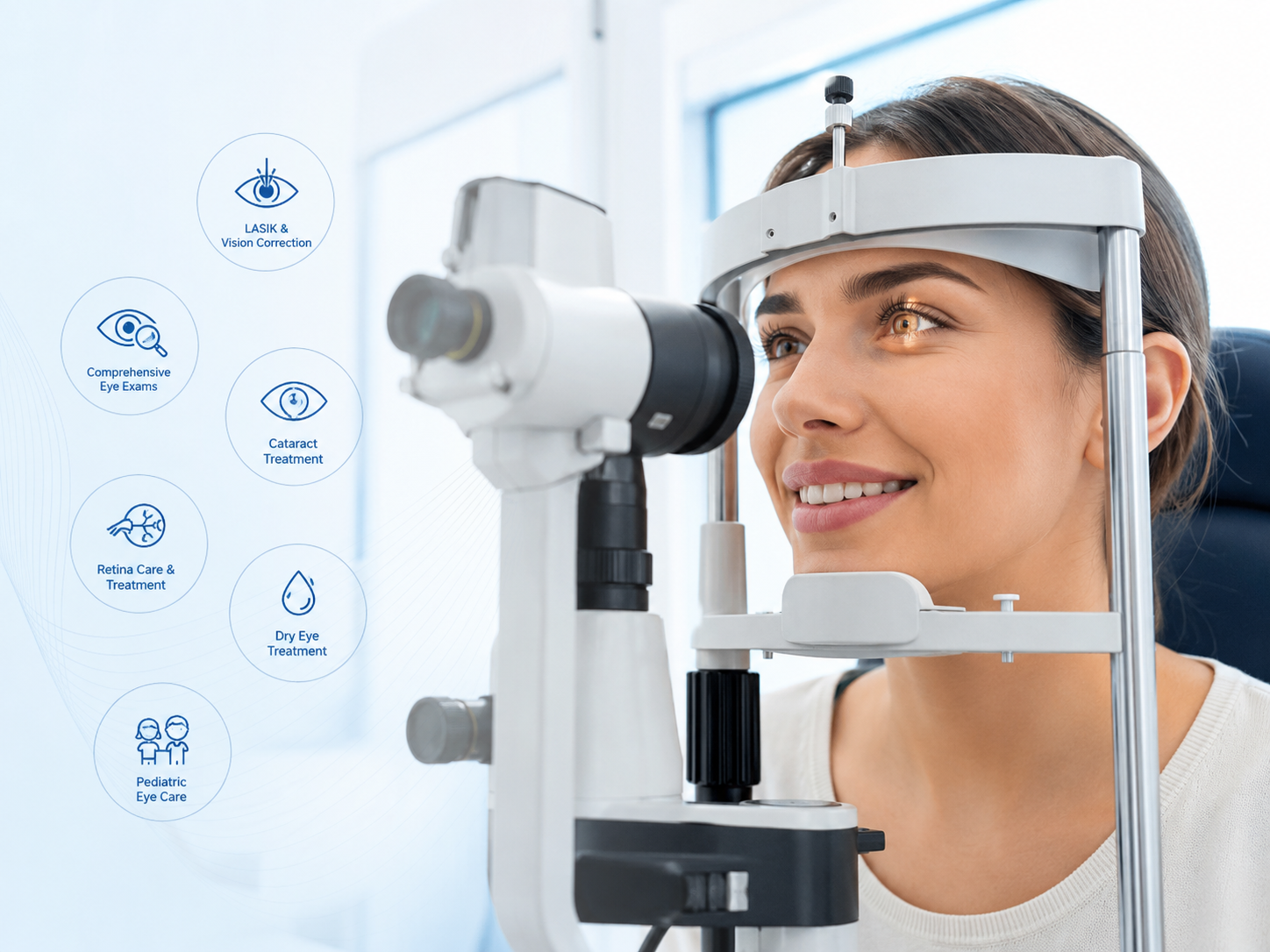
We start with your history and symptoms, then check vision and refraction. A slit-lamp examination looks at the front of the eye, and we measure the pressure inside it. Your pupils are usually dilated so the retina can be seen properly — this blurs near vision for a few hours, so arrange a ride home and bring sunglasses.
Investigations are chosen for your problem, not ordered as a bundle. The OCULUS Pentacam maps corneal shape and thickness, which decides refractive candidacy and picks up keratoconus early. iTRACE separates corneal blur from lens blur. RTVue FD-OCT scans the retina and optic nerve, and the Humphrey Field Analyzer plots your field of vision for glaucoma. If surgery is likely, the ZEISS IOLMaster 700 takes the biometry that sets your lens power.
Your specialist then explains what was found, and what each option would — and would not — do.
As an NABH-accredited eye hospital in Gurugram, we have 20+ years of trust and 1.2 lakh+ eye surgeries behind us. If you are weighing up eye surgery in Gurgaon, this is what that means in practice.
All six sub-specialities sit under one roof, each led by a senior specialist — the doctor who assesses you is the doctor who treats you, not a trainee and not a rotating panel. A diabetic patient needing both a retina review and cataract surgery is managed by consultants on the same corridor.
We run three modular operation theatres — cataract, retina and LASIK — plus an in-patient ward with general, semi-private and private rooms. SMILE and Contoura Vision are both available here, so the technology is matched to your cornea rather than the other way round. Being a single, focused centre also keeps waiting times short.
Indicative starting ranges by procedure family:
| Treatment | Indicative starting range |
|---|---|
| LASIK (standard) | From ₹40,000 |
| PRK / Epi-Contoura / StreamLight | ₹40,000 – ₹70,000 |
| Contoura Vision | ₹95,000 – ₹1,05,000 |
| SMILE | From ₹1,25,000 |
| Cataract surgery (by IOL type) | ₹26,000 – ₹93,000 per eye |
| Glaucoma laser | ₹35,000 – ₹40,000 |
| Trabeculectomy | ₹30,000 – ₹40,000 |
| Glaucoma drainage implant | ₹40,000 – ₹50,000 |
| Pre-surgery screening | ₹3,000 – ₹3,500 |
These are indicative starting ranges, subject to an individual consultation and eye examination. Your final cost depends on your eyes, the lens or technology chosen and your investigation findings.
We offer cashless treatment across empanelled insurers and TPAs, and accept CGHS, ECHS, Ayushman Bharat (PM-JAY) and Haryana Health Department schemes. For self-pay patients, Easy EMI is available through Savein, with EMI also via NBFC partners and select debit cards; a nominal processing fee may apply. LASIK, cataract and retina are EMI-eligible.
See policies and insuranceResults: Individual results vary based on eye condition, prescription/power range, corneal thickness, age, overall eye health and healing response. Outcomes shown or described are not a promise of a specific result.
Pricing: All costs are indicative starting ranges and are subject to an individual consultation and eye examination. They are not a quotation.
Medical: This page is for general information and is not a substitute for a medical consultation, diagnosis or treatment. Please consult with our doctors about your own eyes.
Medically reviewed by Dr. Sanjeev Bisla, Director & Chief Ophthalmologist · Last reviewed: 4 August 2026 · Editorial Policy