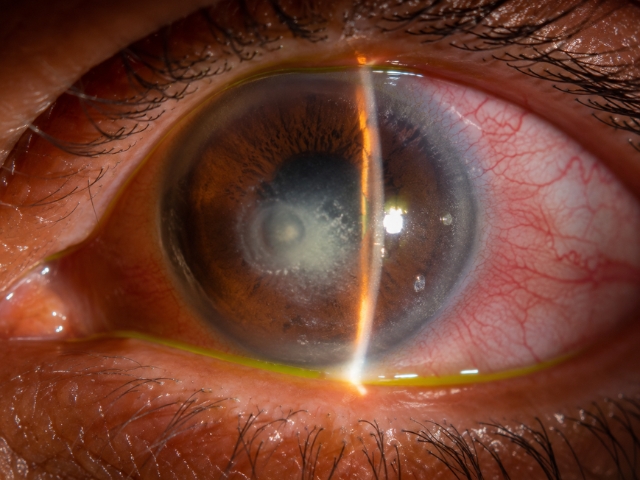
Keratitis is inflammation of the cornea, which may or may not involve infection. Infectious keratitis is caused by bacteria, viruses (such as herpes), fungi or parasites, while non-infectious keratitis can follow injury, dryness or contact-lens overwear. If infection goes deep, it can become a corneal ulcer.
Contact-lens wearers, people with eye injuries (including from farming or dust), and those with a weak ocular surface are most at risk. The key is not to ignore a persistently red, painful eye.
Bacteria — the most common cause of infectious keratitis.
Viruses, such as herpes simplex.
Fungi — often after injury with plant or organic matter.
Parasites, including Acanthamoeba (linked to contact-lens use).
Injury, dust or a scratch to the eye surface.
Contact-lens overwear, sleeping in lenses or poor hygiene.
Most at risk: contact-lens wearers, eye injuries (including farming or dust), and a weak ocular surface.
Keratitis usually comes on over hours to a few days and does not settle on its own. If you notice any of these — particularly together — get your eye examined.
A red, painful eye.
Sensitivity to light.
Watering or discharge.
Blurred vision.
A feeling of something in the eye.
Don’t wait it out: A painful red eye that isn’t settling — especially in a contact-lens wearer — should be seen the same day. Remove your lenses and call +91 81786 39701.
Treatment depends on identifying the cause quickly, then hitting it with targeted anti-infective therapy while the cornea is protected and closely watched.
A slit-lamp assessment and, where needed, a corneal scraping to identify the exact organism — so treatment is targeted rather than guessed.
Antibiotic, antiviral, antifungal or antiparasitic treatment, matched to the cause and started promptly.
Frequent review to confirm the infection is clearing and has not deepened into a corneal ulcer, with treatment adjusted as it responds.
In severe cases that scar or perforate the cornea, a corneal transplant may be required to protect and restore the eye.
Outcomes depend on how early treatment starts and the organism involved. Treatment aims to clear the infection and limit scarring; individual results vary — consult with our doctors promptly.
Indicative, subject to consultation — keratitis care overlaps corneal-ulcer treatment, and the exact plan depends on whether it is managed medically or surgically.
| Treatment | Range |
|---|---|
| Corneal infection / ulcer treatment (medical / surgical) | ₹10,000 – ₹60,000 |
Indicative starting-from ranges (from the centre’s Verified Clinical Data 2024–2025), subject to consultation and examination; insurance/scheme coverage varies by policy.
See the full cornea treatment cost breakdownCornea & Phaco surgeon skilled in corneal cross-linking (CXL), corneal transplantation (keratoplasty), pterygium surgery and dry-eye management — with expertise in managing ocular infection.
Full profile808 B, Galaxy Road, Sector 15 Part 2, Near 32nd Avenue, Gurgaon, Haryana 122001 (just off NH-48, beside 32nd Avenue; nearest metro IFFCO Chowk, Yellow Line).
Phone / WhatsApp: +91 81786 39701 · wecare@dayaleyecentre.in
Monday–Saturday, 8:30 AM – 7:30 PM · Sunday closed (please confirm current timings).
Medically reviewed by Dr. Hem Shah, MBBS, DNB (Ophthalmology) — Cornea & Anterior Segment, Aravind Eye Hospital · Last reviewed: 29 July 2026 · Editorial Policy