Thyroid eye disease (Graves’ orbitopathy) is an autoimmune condition, usually linked to an overactive thyroid, in which the tissues around the eyes become inflamed and swollen — pushing the eyes forward, retracting the eyelids, and affecting the muscles that move the eye.
It runs through an active (inflammatory) phase and then a stable phase, and eye involvement can occur even when your thyroid blood levels are normal — which is why it needs its own specialist eye care, managed alongside your thyroid treatment.
Graves’ orbitopathy · Thyroid orbitopathy · Thyroid-associated ophthalmopathy · Bulging eyes (thyroid)
Oculoplasty & Orbital Surgery
Thyroid eye disease (also called Graves’ orbitopathy) is an autoimmune condition, usually linked to an overactive thyroid, in which the tissues around the eyes become inflamed and swollen. This can push the eyes forward (proptosis), retract the eyelids, and affect the muscles that move the eye — causing double vision.
It has an active (inflammatory) phase followed by a stable phase, and eye involvement can occur even when thyroid blood levels are normal.
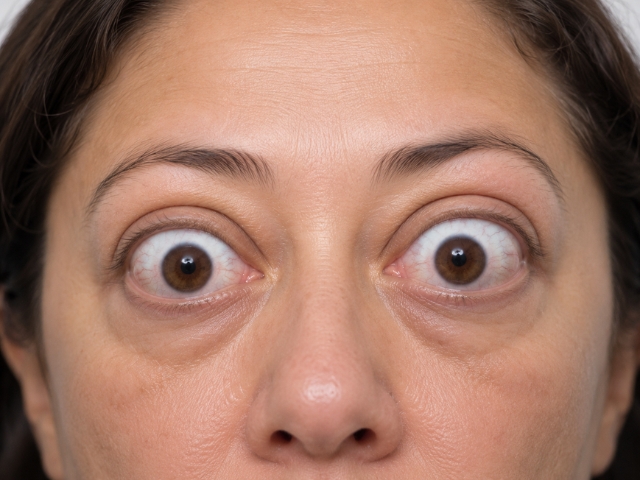
Swollen orbital tissue pushes the eyes forward (proptosis), the most recognised sign of thyroid eye disease.
The eyelids pull back so more of the white shows, giving a staring appearance and leaving the surface exposed.
Inflammation and exposure make the eyes feel gritty, watery and sore, with redness across the surface.
When the muscles that move the eye are affected, the eyes no longer align — causing double vision.
Redness, swelling and discomfort are at their most active. The priority here is protecting the eye and calming inflammation, not changing appearance.
When the disease is no longer active, rehabilitative surgery can address lasting bulging, double vision or lid retraction to restore appearance and function.
Treatment is matched to the phase and severity of the disease — from simple protection and monitoring, through medical control of inflammation, to rehabilitative surgery once things are stable.
Lubricants for comfort, stopping smoking (which worsens the disease), and close monitoring of the eye.
Medical treatment in the active phase for moderate-to-severe disease, to calm the inflammation.
If a crowded orbit begins to threaten the optic nerve, prompt treatment protects your sight.
In the stable phase, surgery restores appearance and vision — in a planned sequence.
Once the disease is stable, surgery restores appearance and vision. The sequence matters, because each step affects the next.
Makes room in a crowded orbit to reduce bulging (proptosis) and relieve pressure.
Realigns the eye muscles to correct double vision once the eyes are stable.
Corrects lid retraction, so the eyelids sit and close naturally again.
Urgent if vision is threatened. If a crowded orbit begins to press on the optic nerve — with fading colour vision or dropping sight — it needs urgent care. Stopping smoking also matters throughout, as it worsens the disease and reduces how well treatment works.
The right treatment, its benefits and any risks depend on the phase and severity of your thyroid eye disease and your overall eye health, and can only be determined after a detailed evaluation with our doctors. Results vary from person to person.
Cost varies by the procedure or procedures needed — orbital decompression, squint surgery and eyelid surgery are very different operations. Your exact cost is shared after assessment. Medically necessary treatment and rehabilitative surgery are usually covered by insurance, subject to your policy — we help with pre-authorisation.
Thyroid eye disease is sub-specialist work that spans medicine and delicate orbital surgery. Here it is led by an internationally trained oculoplastic surgeon, in an accredited hospital built for it.
Internationally trained oculoplastic sub-specialist — an oculoplastic surgeon (AIIMS + Leicester, UK) practising exclusively in eyelid, tear-duct and orbital surgery.
Reconstructive and cosmetic expertise under one roof — a NABH-accredited hospital with three modular operation theatres and an in-patient ward.
20+ years of institutional experience — 1.2 lakh+ surgeries performed at the centre, across every eye speciality.
Affordable, supported access — cashless insurance for medically necessary procedures, Easy EMI and government schemes.
Oculoplasty, orbit & ocular aesthetics · AIIMS + Leicester, UK
An internationally trained oculoplastic surgeon who practises exclusively in periocular plastic and reconstructive surgery. MBBS at Maulana Azad Medical College and MD in Ophthalmology at Dr. Rajendra Prasad Centre for Ophthalmic Sciences, AIIMS New Delhi (Best Senior Resident, 2012), followed by an Oculoplasty & Ocular Aesthetics fellowship at Leicester University, UK. She manages the eye aspects of thyroid eye disease alongside your physician or endocrinologist.
View Full ProfileThe questions patients ask us most about thyroid eye disease. For anything specific to your eyes, a consultation gives the clearest answer.
Medically reviewed by Dr. Saurbhi Khurana and the medical team at Dayal Eye Centre · Last reviewed: 29 July 2026 · Editorial Policy