PRK (Photorefractive Keratectomy) is an effective flapless laser solution for patients looking to move beyond the daily hassle of glasses and contact lenses. The procedure corrects nearsightedness, farsightedness and astigmatism by reshaping the surface of the cornea, with no flap created at any stage.
NABH Accredited1.2 Lakh+ Surgeries20+ Years of TrustSMILE & Contoura Under One RoofSpecialist-LedNABH Accredited1.2 Lakh+ Surgeries20+ Years of TrustSMILE & Contoura Under One RoofSpecialist-Led
The only way to know is a detailed corneal evaluation. Book a PRK consultation and consult with our doctors about your candidacy, options and expected recovery.
PRK reshapes the front surface of your cornea with a cool excimer laser to correct your refractive error — simply, your “glasses number” or power. Unlike flap-based LASIK, it never creates a corneal flap, which is why it is often the preferred route when a flap would be a concern.
PRK Is Worth Discussing If One or More of These Describe You
Candidacy factors consistent with the US FDA’s guidance on laser vision correction — stable refraction, adequate corneal health, no active eye disease. Only a detailed evaluation can confirm.
Thinner cornea:A thinner cornea or a borderline corneal map that makes a LASIK flap less suitable — something we confirm on OCULUS Pentacam corneal tomography, not by guesswork.
High-impact or contact-sport life:Boxing, martial arts, football, wrestling — where having no flap removes the small future risk of flap displacement from an eye injury.
Defence, police, para-military or aviation roles:A flapless surface procedure is sometimes preferred or specified. Eye-fitness criteria differ by board, role and entry route, so always confirm the specific medical standards and post-surgery stand-down period with the recruiting authority before you plan surgery.
If a detailed evaluation shows PRK is not ideal, surgery is not necessarily off the table. Because we offer the full ladder of vision correction under one roof, our surgeons may instead suggest flap-based LASIK, topography-guided Contoura Vision, minimally invasive SMILE — or, for very high powers and corneas unsuited to any laser, a lens-based ICL. Being matched to the right procedure, rather than pushed into one, is the point of specialist-led care.
Know Your Options
How Is PRK Different From LASIK and SMILE?
The biggest difference is the flap. LASIK and SMILE both do their work within the deeper layers of the cornea, while PRK works purely on the surface: the thin outer layer (the epithelium) is gently removed, the laser reshapes the cornea directly, and that layer then heals back naturally over a few days. This is what makes PRK structurally gentle on thinner corneas — more of the corneal architecture is preserved untouched.
PRK vs LASIK vs SMILE — How the Main Options Compare
Procedure
Flap?
First-week recovery
Often best suited for
PRK (surface laser)
No flap — surface only
Slower; a soft bandage contact lens is worn for 3–5 days while the surface heals
Thinner corneas, contact-sport and high-impact lifestyles, some defence/police/aviation aspirants (confirm board criteria)
LASIK (flap-based)
Thin corneal flap created
Fast — many see usefully well within a day or two
Standard powers with adequate corneal thickness
SMILE (ReLEx SMILE)
Flapless, keyhole incision
Quick, gentle on the surface
Myopia with or without astigmatism, dry-eye-prone and active patients
Our surgeons will talk you through each option at your consultation, or you can read our guide on the difference between LASIK and PRK. The right answer depends on your cornea, your power and your lifestyle — not on which procedure sounds newest.
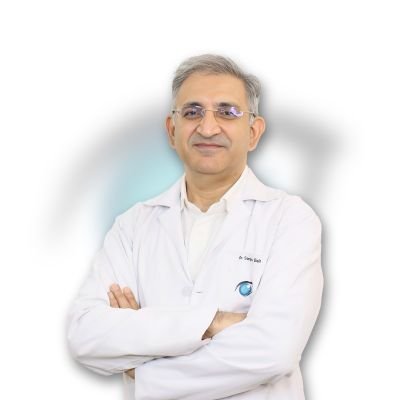
MBBS (GMC Miraj), MS Ophthalmology (PGIMS Rohtak), with fellowships in Phaco and Glaucoma from the renowned Aravind Eye Hospital. A Phaco, Refractive and Glaucoma surgeon with 23+ years of experience and 80,000+ cataract surgeries, he personally performs the full surface-ablation family — PRK, Epi-Contoura and StreamLight — alongside ReLEx SMILE and Femto Contoura.
MBBS (Krishna Institute of Medical Sciences), DNB Ophthalmology, with cornea and anterior-segment specialisation from Aravind, Madurai. His practice spans PRK, Epi-Contoura, Femto Contoura, FemtoLASIK and SMILE — corneal expertise that matters most in exactly the borderline-cornea cases where PRK is chosen.
What Does the Published Evidence Say About PRK and Laser Vision Correction?
We would rather show you the research than make promises.
9 in 10
patients achieve uncorrected vision in the 20/20 to 20/40 range — the band covering most daily activities, including the driving standard.
Source: American Academy of Ophthalmology, patient information.
95.4%
patient satisfaction after laser vision correction in a systematic review of over 2,100 patients published in Ophthalmology.
Source: Solomon et al., Ophthalmology, 2009; n=2,198.
<1%
re-treatment is uncommon with current platforms — enhancement rates of just 0.44% for LASIK and 0.5% for SMILE; surface procedures on modern lasers sit in the same low-single-digit territory.
Source: Indian Journal of Ophthalmology, 2023.
These are findings from published research on laser vision correction, not a promise about your eyes. Individual results vary based on eye condition, prescription/power range, corneal thickness, age, overall eye health and healing response.
The Procedure
What Actually Happens During PRK, and How Does Recovery Feel?
PRK is a quick daycare procedure — you walk in and go home the same day. The laser treatment itself usually takes only a few minutes per eye on our Alcon WaveLight EX500 excimer platform, though you should plan a couple of hours at the centre for preparation and checks, and arrange for someone to accompany you.
1
Numbing Drops
Numbing drops keep the eye comfortable, so you feel pressure and awareness rather than sharp pain.
2
Surface Layer Removed
Instead of creating a flap, your surgeon gently removes the thin surface layer of the cornea (the epithelium).
3
Laser Reshaping
The cool excimer laser reshapes the cornea in seconds according to your personalised plan.
4
Bandage Contact Lens
A soft bandage contact lens is placed to protect the surface while it heals — it usually stays in for a few days, until the epithelium grows back on its own.
A Family of Surface Techniques, Not a Single Procedure
PRK is also a family of techniques at Dayal. Epi-Contoura combines the flapless surface approach with topography-guided treatment mapped to your own cornea on the Contoura system, while StreamLight is a touchless surface technique in which the laser prepares and reshapes the cornea without instruments touching the eye. Which variant suits you depends on your corneal map, your power and your surgeon’s assessment.
The Honest Part — the First Week Is Real Healing Work
We say this plainly because informed patients recover better. While the epithelium closes over the first 3 to 5 days, it is normal to have grittiness, watering, light sensitivity and blurry or fluctuating vision; this is when the bandage lens and prescribed drops do their job. Vision then improves steadily over the following weeks and can keep sharpening for up to a couple of months. It is a slower start than LASIK — we will not pretend otherwise — but for suitable eyes the end result is comparable, and we see you at planned follow-up visits along the way.
Typical PRK Recovery Timeline
Stage
What is typical
Day 0 (procedure day)
Daycare visit; numbing drops; bandage contact lens placed; rest at home
Days 1–5
Epithelium heals; grittiness, watering, light sensitivity; blurry/fluctuating vision; bandage lens removed by your surgeon once healed
Weeks 1–4
Vision steadily clears; most patients resume office work within the first week as comfort allows
Weeks 4–8+
Vision continues sharpening as the surface settles; final outcome assessed at review
Individual results and recovery vary based on your eye condition, prescription/power range, corneal thickness, age, overall eye health and healing response. Timelines above are typical and can vary from person to person.
Cost & Payment
How Much Does PRK Cost in Gurgaon?
PRK cost depends on your eyes and the exact surface technique that suits them, so there is no single flat price. As a guide, surface PRK, Epi-Contoura and StreamLight at our centre start from ₹40,000 and range up to about ₹70,000 per eye (Verified Clinical Data 2023–2025). All figures are starting-from ranges, subject to an individual consultation and eye examination.
Pricing disclaimer: all prices are starting-from ranges, stated per eye, and are subject to an individual consultation and eye examination. Your exact cost is confirmed only after your evaluation.
What Moves the Price
What moves the price is the surface technique used (standard PRK, topography-guided Epi-Contoura or touchless StreamLight) and the complexity of your prescription and cornea.
Because PRK is an elective procedure, insurance cover is generally limited — but we make it easier to plan with Easy EMI (via Savein) and clear, up-front costing.
Every eye is different, so your exact PRK cost is confirmed only after an examination. Consult with our doctors for a clear, personalised estimate and to discuss Easy EMI options.
Refractive surgery is our flagship strength, and it is led from the top — by the senior surgeons above, in an accredited hospital environment rather than a walk-in laser shop.
NABH-Accredited Eye Hospital
Three modular operation theatres and an in-patient ward — quality and safety systems you can verify.
Specialist-Led, Personal Care
You are assessed and treated by senior surgeons, with time to ask questions and no pressure to proceed.
Named Technology at Every Step
Alcon WaveLight EX500 excimer laser for treatment, with OCULUS Pentacam and iTRACE diagnostics for precise corneal mapping and planning.
The Full Ladder of Options
PRK, Epi-Contoura and StreamLight surface techniques, LASIK, Contoura, SMILE and ICL — so we match the method to your cornea and lifestyle, not the other way round.
Trusted Track Record
1.2 lakh+ surgeries, 20+ years of experience, and recognition including the Ayushman Bharat Awards (2021 & 2024).
FAQs
Frequently Asked Questions
PRK is done under numbing eye drops, so during the few minutes of treatment most patients feel pressure and awareness rather than pain. Because it works on the surface, the first three to five days of healing can feel gritty and light-sensitive, with some watering — a soft bandage contact lens and the drops we prescribe help keep you comfortable while the surface grows back.
PRK creates no corneal flap, so it is often preferred when a flap would be a concern — for example if your cornea is on the thinner side, if you are prone to dry eyes, or if you play contact sports or are heading into a career where a knock to the eye is a real possibility. The trade-off is a slower first week of recovery than LASIK, but for suitable eyes the final vision results are comparable.
The soft bandage lens is usually worn for a few days while the surface layer heals (typically 3–5 days). Useful vision usually returns within about a week and then keeps sharpening over the following weeks, sometimes up to a couple of months. Plan a slightly longer break from screens, driving and sport than you would after LASIK.
Often, yes — because there is no flap to be displaced, a flapless surface procedure like PRK is sometimes preferred or specified for contact sports and certain uniformed-service and aviation roles. Requirements differ by board, role and entry route, so always confirm the specific eye-fitness criteria and post-surgery stand-down period with the recruiting authority, and consult with our doctors to plan the timing.
They are surface-ablation variants of PRK offered at Dayal Eye Centre. Epi-Contoura pairs the flapless surface technique with topography-guided treatment mapped to your own cornea, while StreamLight is a touchless technique in which the laser reshapes the cornea without instruments touching the eye. Which one suits you depends on your corneal map, your power and your surgeon’s assessment.
For most suitable patients the correction is long-lasting. In a small minority of eyes, part of the number can gradually return over time (regression), which may be addressed with an enhancement — published enhancement rates for modern laser vision correction are under 1%. Separately, age-related near blur (presbyopia) can still develop later in life, so reading glasses may be needed with age.
Surface PRK, Epi-Contoura and StreamLight start from ₹40,000 and range up to about ₹70,000 per eye, depending on the technique and your prescription, with screening and medicines usually additional. All figures are starting-from ranges, subject to an individual consultation and eye examination. Ask us about Easy EMI via Savein.
In most cases, yes — PRK is commonly performed on both eyes in the same short daycare session, and your surgeon confirms this from your evaluation. Because both eyes then heal at once, it is worth planning a few quieter days off work or study for the initial recovery.
Take the first step toward glasses-light vision with a flapless surface procedure. Our team will assess your candidacy, explain your options and answer every question — with no pressure to proceed.
 Vision Correction
 Cataract
 Retina
 Glaucoma & Cornea
 Paediatric & Speciality
 Oculoplasty
 NABHAccredited