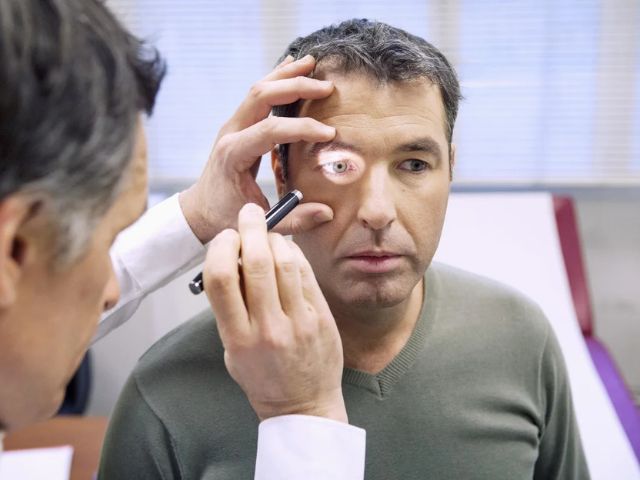
Retinal detachment is a serious eye condition in which the retina — the thin, light-sensitive layer of tissue at the back of your eye — pulls away from the supporting tissue beneath it. This separates the retina from the layer of blood vessels that supplies its oxygen and nourishment. The longer a detachment goes untreated, the higher the risk of permanent vision loss — which is why it is a medical emergency that needs specialist assessment straight away.
Why timing changes everything: when surgery is done promptly, the retina is successfully reattached in around 9 out of 10 eyes with a single operation, and in close to 97–100% of eyes with one or more procedures. Outcomes are best when the detachment is caught early — before the central (macular) vision is affected. Explore our wider retina treatment services to see how detachment surgery fits within our retinal care.
Treat sudden floaters, flashes or a shadow as urgent — the retina should be examined the same day.
We can diagnose a suspected detachment quickly and plan surgery without delay.
With timely surgery the retina is reattached in the large majority of eyes.
Retinal detachment often gives warning signs before or as it happens. Watch for these — and if they appear suddenly, seek help urgently.
Some describe it as “seeing stars” — brief flashes, especially after a knock to the eye or in the dark.
Specks or strings that suddenly drift across your vision, often more than you have seen before.
A sudden or worsening drop in the clarity of your sight.
Gradually reducing peripheral (side) vision, as though your field of view is narrowing.
A curtain-like shadow spreading across your field of vision — the most urgent warning sign of all.
A sudden curtain or shadow is the most urgent sign. If you notice it, call us now — same-day assessment protects your sight.
Call for same-day helpSome people are at higher risk than others. You should be especially alert to the warning signs — and keep up regular retinal checks — if any of these apply to you.
Recognising your own risk is the first step; a dilated retinal examination is the way to confirm whether the retina is healthy.
Are over age 50 — the risk rises with age.
Have had a retinal detachment before, or have a family history of it.
Are highly short-sighted (myopia).
Have had previous eye surgery, such as cataract removal.
Have had a serious eye injury.
Have other eye conditions such as retinoschisis, uveitis or peripheral retinal thinning.
Have diabetes (which can cause tractional detachment).
There are three types of retinal detachment, and identifying which one you have guides the right surgery.
Diagnosis is quick and painless, and lets us plan surgery without delay.
Drops widen the pupil so we can examine the retina in detail through a special lens, supported by optical coherence tomography (OCT) imaging to map the detachment.
A gentle scan of the eye, useful when bleeding or a dense cataract blocks the view of the retina.
Retinal detachment almost always needs surgery, and it is usually urgent. The right procedure depends on the type, size and position of your detachment — our surgeon chooses the approach that gives your eye the best chance. The main options are:
Which surgery suits you is decided after examination. Individual results vary with the type of detachment, how long it has been present, whether the macula was involved, and healing response. Surgery aims to reattach the retina and protect vision — it cannot guarantee a specific level of sight. Consult with our doctors urgently if you have symptoms.
You cannot prevent every detachment, but you can lower your risk and catch it early — which is what protects your sight.
Have regular eye examinations, especially if you are short-sighted, diabetic or over 50.
Keep regular appointments if you already have an eye condition.
Protect your eyes from injury during sport and DIY.
Know the warning signs — sudden floaters, flashes or a shadow — and act on them the same day.
Retinal detachment surgery is priced by the procedure and the complexity of the detachment. Because it is usually urgent, we keep costs transparent and payment straightforward. The ranges below are indicative starting points, confirmed after examination — never a fixed quote.
Easy EMI (via Savein), cashless treatment across our empanelled insurers and TPAs, and government/PSU schemes are available. Retinal detachment surgery is commonly covered — our team assists with pre-authorisation quickly.
Figures are indicative starting points and vary by the type and complexity of detachment, the procedure used, and whether silicone oil is required. Final costs follow examination; insurance/scheme coverage varies by policy.
When sight is time-critical, you want an experienced retina team that can act fast.
Fellowship-trained vitreoretinal surgeon — performing pneumatic retinopexy, scleral buckle and vitrectomy.
Full surgical capability on site — three modular operation theatres and an in-patient ward under one NABH-accredited roof, so urgent surgery isn’t delayed by referral.
20+ years and 1.2 lakh+ surgeries — of institutional experience across the retina service.
Rapid diagnostics — OCT and ocular ultrasound available to confirm and plan without delay.
Affordable, supported access — with cashless insurance, Easy EMI and government schemes.
MBBS, DNB (Gold Medalist)
Dr. Khatwani works across medical and surgical retina, ROP and uveitis, and has performed numerous retinal surgeries — including retinal detachment repair — at Dayal Eye Centre.
Read Dr. Neelam Khatwani’s full profileThe questions patients and families ask us most about retinal detachment. For anything specific to your eyes, an urgent consultation gives the clearest answer.
Medically reviewed by Dr. Neelam Khatwani, Retina Specialist, Dayal Eye Centre · Last reviewed: 29 July 2026 · Editorial Policy