Orbital disease covers conditions affecting the eye socket and the tissues around the eye — tumours (benign or malignant), inflammation, infection (orbital cellulitis), thyroid eye disease, and injuries such as orbital fractures.
Because the orbit is a confined space packed with important structures, changes here need prompt, careful evaluation — often with imaging. Some causes are sight-threatening, so a bulging, painful or fast-changing eye should be assessed by a specialist rather than watched.
Orbital tumour · Proptosis (bulging eye) · Eye socket disease
Oculoplasty & Orbital Surgery
Several very different problems can develop in the same small, crowded space behind and around the eye. Identifying which one it is — and how urgent it is — is the first job of a specialist assessment.
Growths in the eye socket, benign or malignant, that can push the eye forward or affect its movement. Imaging and sometimes a biopsy establish what they are.
Orbital inflammation, and infection such as orbital cellulitis, can cause swelling, redness and pain. Cellulitis is an emergency and treated urgently.
Thyroid-related changes crowd and enlarge the orbital tissues, bulging the eye and, in some cases, needing decompression to make room.
Trauma to the socket can fracture the orbital walls, trap eye muscles and cause double vision — repaired to restore position and movement.
Any of these — especially if they appear quickly or come with pain — should be assessed promptly.
A forward-bulging eye (proptosis)
Double vision
Restricted or painful eye movement
Swelling around the eye or socket
Reduced or changing vision
Pain in or behind the eye
Diagnosis pins down the exact cause; treatment is then targeted to it — and can range from medication alone to precise orbital surgery. We recommend the least invasive effective approach.
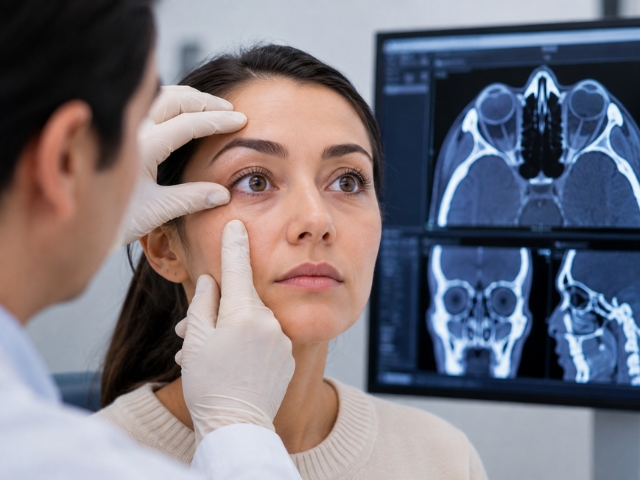
Detailed examination — a full orbital and eye assessment to gauge the position, movement and vision of the affected eye.
Imaging (CT / MRI) — scans map the orbit and its contents to locate and characterise the problem precisely.
Biopsy where needed — a tissue sample is taken when the cause of a growth needs to be confirmed before treatment.
Medical therapy — inflammation is often settled with medication alone, without surgery.
Tumour removal & drainage — surgery to remove a tumour or drain an infection that needs it.
Orbital decompression — more room is created for a crowded orbit, as in thyroid eye disease.
Fracture repair — orbital fractures are repaired to free trapped muscle and restore the eye’s position.
Treated urgently to protect sight. Serious orbital conditions — such as orbital cellulitis or a rapidly bulging eye — are sight-threatening and cannot wait. If your eye is fast-changing, painful or losing vision, call us the same day.
The right treatment, its benefits and any risks depend on the exact cause and stage of the orbital condition and your overall eye health, and can only be determined after a detailed evaluation with our doctors. Results vary from person to person.
Orbital cost varies widely by condition, so these are indicative ranges only, confirmed after consultation. Medically necessary orbital treatment and surgery are usually covered by insurance, subject to your policy — we help with pre-authorisation.
Orbital surgery is delicate, sub-specialist work. Here it is led by an internationally trained oculoplastic surgeon, in an accredited hospital built for it.
Internationally trained oculoplastic sub-specialist — an oculoplastic surgeon (AIIMS + Leicester, UK) practising exclusively in eyelid, tear-duct and orbital surgery.
Reconstructive and cosmetic expertise under one roof — a NABH-accredited hospital with three modular operation theatres and an in-patient ward.
20+ years of institutional experience — 1.2 lakh+ surgeries performed at the centre, across every eye speciality.
Affordable, supported access — cashless insurance for medically necessary procedures, Easy EMI and government schemes.
Oculoplasty, orbit & ocular aesthetics · AIIMS + Leicester, UK
An internationally trained oculoplastic surgeon who practises exclusively in periocular plastic and reconstructive surgery. MBBS at Maulana Azad Medical College and MD in Ophthalmology at Dr. Rajendra Prasad Centre for Ophthalmic Sciences, AIIMS New Delhi (Best Senior Resident, 2012), followed by an Oculoplasty & Ocular Aesthetics fellowship at Leicester University, UK.
View Full ProfileThe questions patients ask us most about orbital disease. For anything specific to your eyes, a consultation gives the clearest answer.
Medically reviewed by Dr. Saurbhi Khurana and the medical team at Dayal Eye Centre · Last reviewed: 29 July 2026 · Editorial Policy