Diabetic retinopathy is a serious eye condition that can develop in anyone with diabetes. Persistently high blood sugar damages the tiny blood vessels in the retina — the light-sensitive layer at the back of the eye — and over time these vessels leak fluid or blood, or close off, threatening your vision. It is one of the leading causes of blindness in working-age adults, and often the reason vision changes are the first sign someone has diabetes at all.
Why this matters for you: India has one of the largest diabetic populations in the world — an estimated 101 million people are living with diabetes (ICMR-INDIAB, The Lancet Diabetes & Endocrinology, 2023). Studies of Indians with diabetes have found diabetic retinopathy in roughly 1 in 6 (about 16.9%), with sight-threatening disease in around 3.6%.
The reassuring part: with early detection and proper treatment, most serious vision loss can be prevented, which is exactly why a yearly dilated eye check with a retina specialist is so valuable. Explore our full retina treatment services to see how diabetic eye care fits in.
Anyone with diabetes — type 1 or type 2 — and the risk rises the longer diabetes has been present.
Significant damage can build with no symptoms at all, so a yearly dilated eye check is your safeguard.
Caught early and treated properly, serious sight loss from diabetic retinopathy can usually be avoided.
Diabetic retinopathy progresses through two main stages, and telling them apart guides the entire treatment plan.
The earlier stage, where retinal blood vessels weaken, balloon and leak, but no new vessels have grown yet. Many people have no symptoms at this stage — which is why screening finds it before you would.
The advanced stage, where fragile new blood vessels grow on the retina. These can bleed into the eye and pull on the retina, causing sudden, serious vision loss if untreated.
Diabetic Macular Edema is the most common reason people with diabetes lose reading and detail vision. It is a complication of diabetic retinopathy in which leaking vessels cause fluid to build up in the macula — the central part of the retina responsible for sharp, straight-ahead vision.
The result is blurred or distorted central vision. DME can appear during either the NPDR or PDR stage, and it is very treatable when caught in time.
In its early stages, diabetic retinopathy usually has no symptoms at all — which is the single most important thing to understand about it. As it advances, you may notice:
A drop in clarity, or straight lines appearing wavy.
Dark spots or strings drifting across your vision, sometimes from bleeding inside the eye.
Particularly in advanced disease, when fragile new vessels bleed.
The early stage is silent — screen yearly. Because significant damage can be present even when your vision still feels fine, routine eye checkups with a retina specialist are the only reliable way to catch it early. If you have diabetes and haven’t had a dilated retinal exam this year, consult with our doctors.
Book a dilated eye checkFor anyone with diabetes, regular eye exams are essential — even with no symptoms. Our assessment may include:
Measures how sharply you can see.
Eye drops widen the pupil so we can examine the retina and its blood vessels in detail.
Detailed retinal images that document changes and give us a baseline to track over time.
A quick, comfortable scan that detects fluid and swelling in the macula — key for diagnosing DME.
A dye highlights leaking or blocked retinal vessels, mapping exactly where the disease is active.
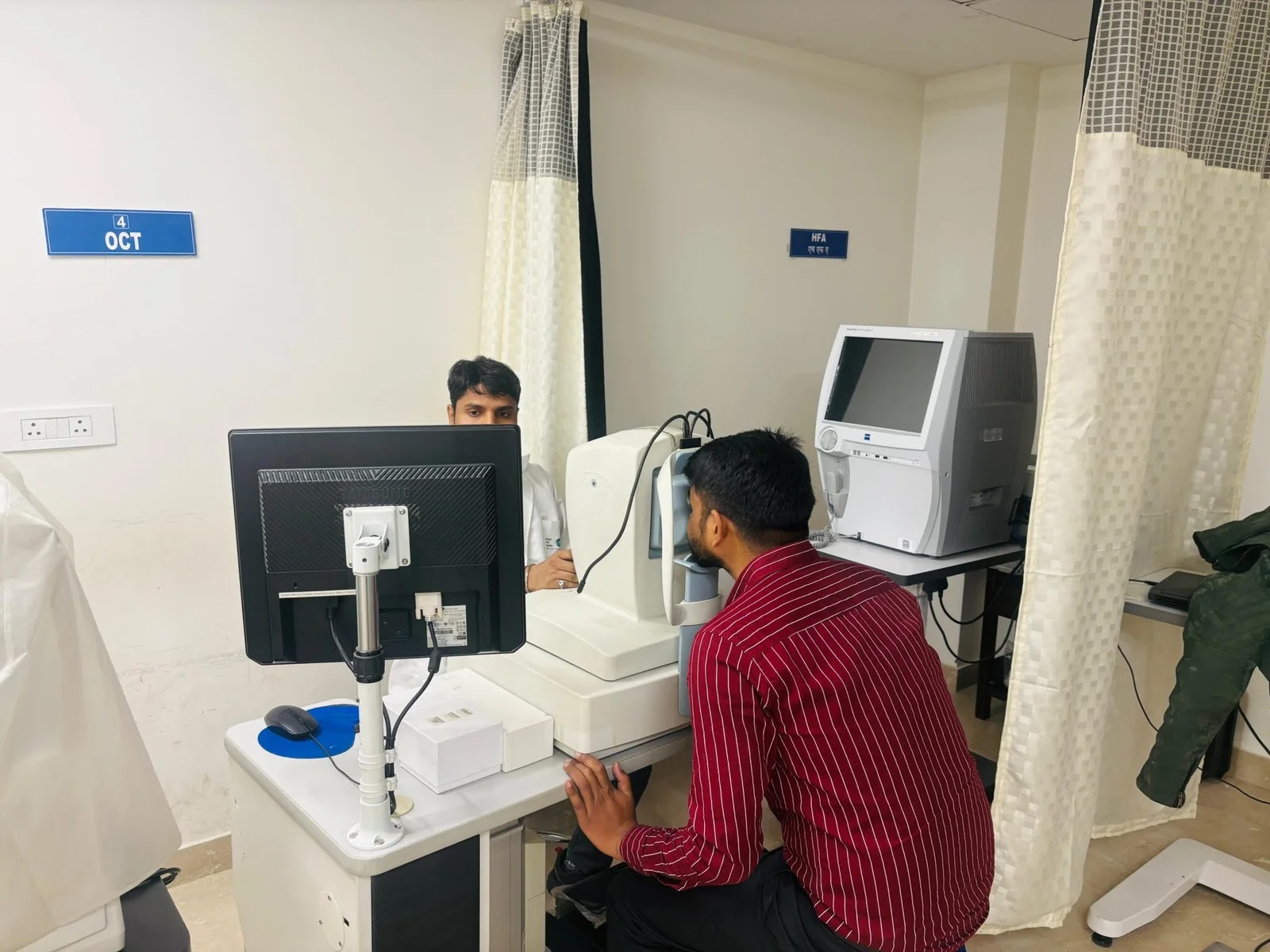
Visual acuity, dilated exam, fundus photography, OCT and angiography where needed — all in-house, so your plan is decided the same day.
Book a dilated retinal assessmentThe goal of treatment is to prevent further retinal damage and preserve the vision you have. Your plan depends on the stage and severity — and often combines controlling the diabetes itself with targeted eye treatment.
Keeping blood sugar, blood pressure and cholesterol in a healthy range is the most powerful thing you can do — consistently high sugar drives the damage. We work alongside your physician so eye care and diabetes care pull in the same direction.
Regular exams catch problems early; not smoking, managing blood pressure and a balanced diet all support your eyes. See our eye nutrition guidance for practical steps.
Focal laser seals leaking vessels to reduce swelling, while panretinal photocoagulation treats abnormal new vessels in advanced disease to lower the risk of bleeding and further loss.
Anti-VEGF medicines are the mainstay for diabetic macular edema and much proliferative disease — in studies they stabilise vision in roughly 9 in 10 patients. In one trial of high-risk early disease, anti-VEGF cut vision-threatening complications from about 20% to 4%. Steroid injections help in selected cases, and injections are given as a planned course, not a one-off.
For advanced disease with bleeding into the eye or scar tissue pulling on the retina, vitrectomy — keyhole surgery to clear the vitreous gel and stabilise the retina — can restore or protect vision. We assess whether you need it and explain honestly what it can and cannot achieve.
Individual results vary based on the stage of disease, blood-sugar control, how long diabetes has been present, and overall eye health. Treatment aims to protect vision, not guarantee a specific outcome — consult with our doctors for a plan built around your eyes.
Because diabetic retinopathy is progressive, consistent follow-up protects the gains from treatment.
Annual, or more often depending on your stage of disease.
Keeping blood sugar, blood pressure and cholesterol controlled to slow progression.
Regular activity, a healthy diet and not smoking all support better eye and overall health.
For comprehensive diabetic eye care, our experienced retina team provides personalised treatment to preserve and enhance your vision, including low vision treatment where sight has already been affected. You can also read about Dr. Neelam Khatwani, our retina specialist, for expert guidance on diabetic retinopathy and other retinal disorders.
There is no single price for diabetic retinopathy care, because treatment depends on your stage — from monitoring, to laser, to a course of injections, to surgery. The indicative ranges below help you plan; they are a starting point, not a fixed quote, and your plan is confirmed only after an examination.
Easy EMI (via Savein), cashless treatment across our empanelled insurers and TPAs, and government/PSU schemes are available. Diabetic retinopathy treatment is commonly covered — our team helps you check your policy.
Figures are indicative starting points and vary by stage, the number of injections or laser sessions needed, and the drug or lens used. Final costs follow a consultation and examination; insurance/scheme coverage varies by policy.
Diabetic eye disease is a long-term relationship, not a one-visit fix — so the team you choose matters.
Fellowship-trained retina specialist — leading screening, laser, injections and surgery — you see an experienced sub-specialist every time.
Full treatment ladder under one roof — OCT, angiography, laser, anti-VEGF and vitrectomy on a single NABH-accredited site, with three modular operation theatres.
20+ years and 1.2 lakh+ surgeries — of institutional experience, with special interest in diabetic retinopathy and macular disease.
Coordinated diabetic care — we work with your physician so your sugar control and eye treatment reinforce each other.
Affordable, supported access — with cashless insurance, Easy EMI and government schemes.
MBBS, DNB (Gold Medalist)
Dr. Khatwani completed fellowships in vitreo-retina surgery at H.V. Desai Eye Hospital, Pune and in medical retina at Shroff Eye Centre, Delhi. She has 8+ years of experience treating diabetic retinopathy and diabetic macular edema.
Read Dr. Neelam Khatwani’s full profileThe questions patients and families ask us most about diabetic eye care. For anything specific to your eyes, a consultation gives the clearest answer.
Medically reviewed by Dr. Neelam Khatwani, Retina Specialist, Dayal Eye Centre · Last reviewed: 29 July 2026 · Editorial Policy