NABH Accredited 20+ Years 1.2 Lakh+ Surgeries International Patients Mon–Sat · 8:30 AM–7:30 PM +91 81786 39701
NABH Accredited
Dayal Eye Centre
Contact
Book an AppointmentHow would you like to go ahead?
Self BookingPick your doctor, date and slot. Booking RequestLeave your number — our counsellors call you. Mon–Sat 8:30 am – 7:30 pm · Sunday closed
NABH · Gurugram

Need a second opinion on your eyes?

Leave your number. A specialist calls you back today.

Available now

Call us from your phone

Copy the number, or leave your details and we will call you back.

+91 81786 39701

Mon–Sat · 8:30 AM–7:30 PM · Sector 15, Gurugram
Diagnostic · Ray-Tracing Aberrometry

iTRACE Test in Gurgaon: Ray-Tracing Aberrometry and Corneal Topography

The scan our surgeons use to find where blur is actually coming from — your cornea, or the lens inside your eye.

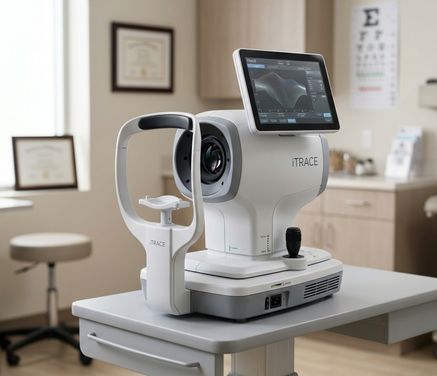
iTRACE ray-tracing aberrometer at Dayal Eye Centre, Gurgaon
iTRACE · Ray-Tracing Aberrometer
NABH
Accredited hospital
1.2 Lakh+
Eye surgeries
20+
Years of trust
Specialist
Led, six sub-specialities

Some of the most frustrating vision problems never show up on a standard eye test. Your glasses number looks fine, your retina looks healthy — and yet headlights spread into starbursts at night and new glasses do not fix it. The iTRACE scan at Dayal Eye Centre in Gurgaon is how our surgeons find where that blur is actually coming from.

This page is for you if you are being assessed for laser vision correction, weighing cataract surgery against a premium lens implant, or simply not seeing as sharply as your prescription says. The iTRACE is a diagnostic instrument — it maps your eye's optics, treats nothing, and never touches your eye.

What can the iTRACE tell us that a normal eye test cannot?

A routine refraction gives us your sphere and cylinder — your power, technically your lower-order aberrations. That is the part glasses can correct.

The iTRACE goes further. Using ray tracing aberrometry, it sends thin beams of light into your eye one at a time and measures where each lands on the retina. From that it calculates your higher-order aberrations — coma, spherical aberration, trefoil — the finer irregularities behind glare, halos and starbursts, which glasses cannot correct. It also maps your corneal topography, the shape of the eye's front surface.

Comparing what the whole eye does with what the cornea alone does separates error arising from your cornea from error arising from the internal optics — chiefly the natural lens, or an implanted intraocular lens. So two patients can share a glasses number for different reasons: one has a slightly irregular cornea and a clear lens; the other, a smooth cornea and a lens beginning to yellow and scatter light. The number is identical. The right plan is not.

It also measures angle kappa and angle alpha, the offset between your line of sight and your pupil centre — important when a lens implant must be centred.

iTRACE analysis display — corneal, internal and total aberration maps
The Question That Changes the Plan

Is your blur coming from your cornea or your lens?

For patients in their fifties and sixties this is usually the real question, and it is where the iTRACE contributes most. The natural lens does not go cloudy overnight — long before a cataract (motiyabind, or safed motia) is obvious on examination, it starts losing optical quality: it scatters light, contrast drops, night driving gets harder. The iTRACE calculates a Dysfunctional Lens Index, a score drawn from internal aberrations and light scatter that indicates how much of your blur comes from the lens rather than the cornea.

If the cornea is the source
The lens still performs well

If the cornea is doing most of the damage, LASIK or another form of laser vision correction may be the route to discuss.

If the lens is the source
Reshaping the cornea will not fix it

A lens-based procedure such as Cataract Surgery becomes the more logical conversation.

It is genuinely possible to have laser correction on an eye whose real problem is the lens, and to be disappointed later. Suitability depends on a detailed evaluation — not every patient is a candidate, and we will tell you plainly if you are not.

How does the iTRACE help plan laser vision correction?

The iTRACE supplies the optical half of the picture, measuring your higher-order aberrations so our surgeons know what night-vision symptoms you already have before anything is planned — not afterwards.

That sits alongside corneal shape and thickness data from the OCULUS Pentacam, which maps both corneal surfaces in three dimensions. Together they show whether your cornea is healthy and thick enough to treat, and whether a topography-guided plan would suit you better than a standard one.

Where appropriate, that plan is delivered on the Alcon WaveLight EX500 excimer laser using Contoura Vision topography-guided ablation, which treats your corneal map rather than your spectacle number alone. Whether you are a candidate is decided at consultation.

How does the iTRACE help plan cataract and premium IOL surgery?

If you are considering a multifocal, extended-depth or toric intraocular lens, the iTRACE data does three things.

It gives our surgeons your angle kappa, angle alpha and visual axis, which guide how a multifocal or toric lens should be centred — a lens sitting off the visual axis is a recognised reason for glare afterwards. It assesses corneal astigmatism, the basis of any toric plan. And it helps set realistic expectations: if your cornea shows significant higher-order aberrations, a premium multifocal may not deliver the crispness you hope for, and our surgeons will say so before you pay for one.

It works alongside the ZEISS IOLMaster 700, which supplies the optical biometry used to calculate lens power. The iTRACE describes optical quality; the IOLMaster 700 gives the numbers for the lens.

What the iTRACE measures and where it changes the plan

What it measuresIn plain languageWhere it changes the plan
Lower-order aberrationsYour glasses number — power and astigmatismCross-checks your refraction
Higher-order aberrations (coma, spherical aberration, trefoil)Flaws glasses cannot correct — glare, halos, starburstsStandard versus topography-guided laser plan; flags poor multifocal candidates
Corneal topographyShape of the eye's front surfaceCorneal regularity; toric planning
Corneal vs internal (lens) splitWhether blur comes from the cornea or from inside the eyeCorneal versus lens-based procedure
Dysfunctional Lens IndexHow much blur the natural lens causesWhether cataract surgery is more logical than laser correction
Angle kappa / alpha and visual axisHow far your line of sight sits from your pupil centreCentration of multifocal and toric lenses
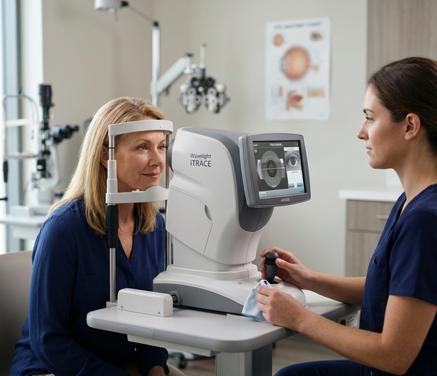
Patient positioned at the iTRACE — a non-contact scan at Dayal Eye Centre

What is the iTRACE test like for you?

You rest your chin on a padded rest, look at a small target inside the instrument, and hold still for a few seconds. That is the whole test.

The iTRACE is non-contact — nothing touches your eye. There is no injection and no needle, the scan takes seconds per eye, and most patients find it comfortable. Drops are not needed for the scan itself, though your doctor may dilate your eyes for other parts of a full assessment. Results are ready immediately and reviewed with you the same visit.

Who interprets your iTRACE results?

The instrument produces maps and numbers. The decision is made by a surgeon.

Dr. Sanjeev Bisla
Director & Chief Ophthalmologist

Scans are read by our Director — MBBS (GMC Miraj), MS Ophthalmology (PGIMS Rohtak), PHACO and Glaucoma fellowships from Aravind Eye Hospital, 23 years' experience and more than 80,000 cataract surgeries.

Dr. Hem Shah
Cornea & Phaco Specialist

Corneal cases are also reviewed by our cornea and phaco specialist — MBBS, DNB Ophthalmology, with cornea and anterior segment specialisation at Aravind Eye Hospital, Madurai.

Dayal Eye Centre is NABH-accredited, with 20+ years of trust, 1.2 lakh+ eye surgeries and six sub-specialities under one roof — so whatever the scan shows, the specialist who needs to see it is in the same building.

Consult with our doctors about your iTRACE scan

If your vision is blurred, glare-heavy or not as sharp as your prescription suggests, an iTRACE test in Gurgaon can help our surgeons explain why. Consult with our doctors about whether this test belongs in your assessment.

Dayal Eye Centre

808 B, Galaxy Road, Sector 15 Part 2, Near 32nd Avenue, Gurgaon, Haryana 122001

Beside 32nd Avenue (~150 m), just off NH-48. IFFCO Chowk metro ~3.5 km. On-site parking, ramps and lifts.

Monday–Saturday, 8:30 AM – 7:30 PM. Sunday closed.

Our medical counsellors will contact you — No Sales, Expert Consultation.

Frequently Asked

Frequently asked questions about the iTRACE test

What is an iTRACE test?+
It is a diagnostic scan combining ray-tracing aberrometry with corneal topography in one instrument. It measures your glasses number and the higher-order aberrations glasses cannot correct, maps your cornea, and separates error coming from the cornea from error coming from inside the eye. It performs no treatment.
Why do I need an iTRACE if I have already had a corneal scan?+
They measure different things. A corneal tomography scan such as the OCULUS Pentacam maps the cornea's shape, curvature and thickness. The iTRACE measures the optical performance of the whole eye, including the lens, then works out how much error belongs to each.
Does the iTRACE test hurt, or do I need drops?+
Nothing touches your eye — the scan is non-contact, with no injection and no needle, and most patients find it comfortable. Drops are not needed for the iTRACE itself, though your doctor may dilate your eyes for other parts of the examination.
Can the iTRACE tell me whether I need cataract surgery or LASIK?+
Not on its own. It contributes important evidence — the Dysfunctional Lens Index and the cornea-versus-lens split — about where your blur originates, weighed alongside your examination, scans, biometry and symptoms. Your surgeon makes the recommendation; the machine does not.
How long does an iTRACE test take?+
Seconds per eye, and a few minutes in total including positioning. Results are available immediately and discussed in the same consultation.
Is an iTRACE needed for every patient?+
No. For a routine eye check or a change of glasses it is not required. We use it where the optical detail changes a decision — refractive surgery assessment, premium lens planning, unexplained glare, and cases where your glasses number does not explain your symptoms.

Results: Individual results vary based on eye condition, prescription/power range, corneal thickness, age, overall eye health and healing response. Outcomes shown or described are not a promise of a specific result.

Medically reviewed by Dr. Sanjeev Bisla, MBBS, MS (Ophthalmology), Director — Dayal Eye Centre · Last reviewed: 24 July 2026 · Editorial Policy