NABH Accredited 20+ Years 1.2 Lakh+ Surgeries International Patients Mon–Sat · 8:30 AM–7:30 PM +91 81786 39701
NABH Accredited
Dayal Eye Centre
Contact
Book an AppointmentHow would you like to go ahead?
Self BookingPick your doctor, date and slot. Booking RequestLeave your number — our counsellors call you. Mon–Sat 8:30 am – 7:30 pm · Sunday closed
NABH · Gurugram

Need a second opinion on your eyes?

Leave your number. A specialist calls you back today.

Available now

Call us from your phone

Copy the number, or leave your details and we will call you back.

+91 81786 39701

Mon–Sat · 8:30 AM–7:30 PM · Sector 15, Gurugram

Technology & Equipment · Refractive

Contoura Vision Topography-Guided Ablation

NABH Accredited 1.2 Lakh+ Surgeries 20+ Years of Trust Specialist-Led

Two people can share the same glasses number and still see the world differently — one reads the number plate cleanly at dusk, the other sees a halo around every streetlight. That difference usually sits on the surface of the cornea, the clear front window of the eye, and a prescription never records it. Topography-guided ablation is the planning method we use at Dayal Eye Centre when the laser correction should be shaped around your own corneal surface, not only around the sphere and cylinder on your spectacle slip.

Topography-guided laser vision correction at Dayal Eye Centre
1.2 Lakh+
Eye surgeries performed
80,000+
Cataract surgeries by our Director
20+
Years of trust
3
Modular operation theatres
NABH
Accredited hospital
The Science

What does topography-guided ablation actually measure?

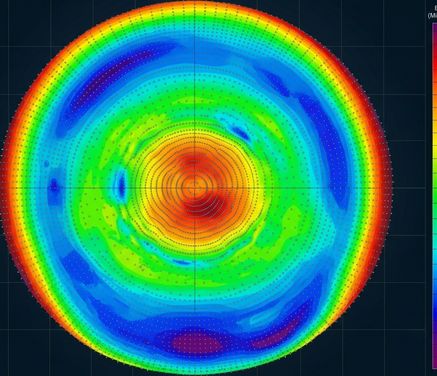
Corneal topography is a map of the front surface of your eye. Like a survey map, it records height and curvature at thousands of separate points across the cornea rather than one average. Elevation mapping shows how far each point sits above or below an ideal smooth curve.

Your glasses prescription captures only two kinds of focusing error — and it cannot record anything finer. Topography-guided planning accounts for that second layer, factoring the irregularities of your actual surface into the plan alongside your power.

Corneal topography elevation map showing thousands of measured points
Lower-order aberrations
Sphere & cylinder

Sphere is your overall power — how nearsighted (myopia) or farsighted (hyperopia) you are. Cylinder is astigmatism, where the cornea is shaped a little more like a rugby ball than a football. Spectacle lenses correct these well.

Higher-order aberrations
Coma, trefoil & spherical aberration

Smaller, more complex distortions in the way light passes through the eye — too subtle and too oddly shaped for a spectacle lens to cancel out. They show themselves in dim light, when the pupil opens wider, which is why some people see well on a vision chart but struggle at night.

From Cornea to Correction

How is your treatment plan built from your own cornea?

Instruments gather the maps; a refractive surgeon interprets them and decides what the laser will do. Nothing about it is automated end to end.

01
Corneal mapping

We begin on the OCULUS Pentacam, a rotating-camera scanner that images the front and back surfaces of the cornea and measures its thickness across the whole map. It tells us the shape we are working with and whether there is enough healthy tissue to treat safely.

02
Ray-tracing aberrometry

The iTRACE traces rays of light through your eye, separating how much of your blur comes from the cornea and how much from the lens inside it. It also quantifies your higher-order aberrations — the number that matters most when the complaint is night glare rather than blur.

03
Surgeon planning

Dr. Sanjeev Bisla or Dr. Hem Shah reviews the topography, elevation and aberrometry maps side by side, checks that repeat scans agree, and builds the ablation profile: the exact pattern of tissue the laser will remove, point by point, to correct the power and smooth surface irregularities in one pass.

04
Delivery

The profile is transferred to the Alcon WaveLight EX500 excimer laser, which delivers it with high-speed eye tracking to keep each pulse on target if your eye moves.

The division of work matters: the Pentacam and iTRACE are diagnostic instruments that measure. Topography-guided ablation is a treatment method that corrects.

Choosing a Method

Conventional vs wavefront-optimised vs topography-guided planning

Three ways to plan a laser correction, and what each is based on. Which fits you is a clinical decision made after your scans, not a menu choice.

Conventional
Based on

Your spectacle prescription alone (sphere and cylinder).

Can address

Nearsightedness, farsightedness and regular astigmatism.

Typically considered for

Straightforward prescriptions, regular corneal maps, no significant higher-order aberrations.

Wavefront-optimised
Based on

Your prescription plus a standard adjustment for corneal curvature.

Can address

The same errors, with a profile shaped to reduce induced spherical aberration at the corneal periphery.

Typically considered for

Regular corneas, where the aim is a predictable correction with less risk of adding new aberrations.

Contoura Vision
Topography-guided
Based on

Thousands of measured points from your own corneal map, plus your prescription.

Can address

Your power together with measured surface irregularities and corneal higher-order aberrations.

Typically considered for

Measurable corneal irregularity, or night glare, haloes and poor contrast despite a good chart reading.

Consult with our doctors before assuming any one method suits your eyes — the right choice follows your measurements.

Book a Consultation
Why It Matters for You

Why does this matter for night vision and glare?

Higher-order aberrations are a well-recognised contributor to glare, haloes around lights and reduced contrast in low light. Because they scale with pupil size, they become noticeable exactly when vision matters most — driving after dark.

Topography-guided planning is designed to address surface irregularities alongside the power correction, not the power alone. Published studies of topography-guided LASIK report high rates of 20/20 (6/6) or better uncorrected vision and better patient-reported quality of vision, including night-vision symptoms, compared with conventional LASIK.

Those are research findings across groups of patients, not a forecast for any one eye. Individual results vary and no outcome can be promised. Some glare has causes this treatment cannot touch — early cataract, dry eye, a large pupil — which is why we investigate your symptoms first.

Candidacy

Who is topography-guided treatment suitable for?

Broadly, we look for a stable prescription, corneal maps regular enough to guide a plan, enough corneal thickness for the tissue the treatment removes, and a sound cornea and tear film.

Not every eye is suited, and corneal thickness and corneal health usually decide it. Where they do not permit it we will say so plainly and discuss what does fit — SMILE, PRK or a lens-based option such as an implantable collamer lens. Full candidacy, recovery and cost sit on our Contoura Vision surgery page.

A stable prescription — your power has not shifted materially in recent visits.
Corneal maps regular enough to guide a plan — the topography can direct the laser reliably.
Enough corneal thickness — for the tissue the treatment removes.
A sound cornea and tear film — healthy surface conditions for a lasting result.
Specialist-Led

Who plans and performs it here?

Both work in an NABH-accredited hospital with three modular operation theatres — cataract, retina and LASIK — backed by 20+ years of trust and 1.2 lakh+ eye surgeries. SMILE and Contoura Vision are both available under one roof, so your recommendation follows your scans rather than whichever technology is in the building.

Dr. Sanjeev Bisla, Director & Chief Ophthalmologist at Dayal Eye Centre
Director & Chief Ophthalmologist

MS Ophthalmology (PGIMS Rohtak), with PHACO and Glaucoma fellowships from Aravind Eye Hospital. Across 23 years he has performed 80,000+ cataract surgeries.

Refractive work includes Femto Contoura, Epi-Contoura, StreamLight, ReLEx SMILE and PRK.

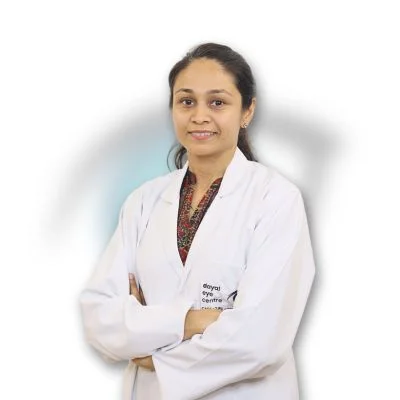
Dr. Hem Shah, Cornea & Refractive Surgeon at Dayal Eye Centre
Cornea & Phaco Specialist

DNB Ophthalmology, with cornea and anterior segment specialisation at Aravind Eye Hospital, Madurai.

Performs FemtoLASIK, Femto Contoura, Epi-Contoura, PRK, SMILE, SILK and corneal transplants.

Good to Know

Frequently asked questions

Is Contoura Vision the same as LASIK?+
It is a way of planning a LASIK treatment, not a separate operation. The surgical steps are those of LASIK; what differs is that the ablation profile is built from your own corneal map rather than your prescription alone.
Do I need extra tests for topography-guided treatment?+
Yes. Beyond a routine refraction and eye examination, we need corneal tomography on the Pentacam and ray-tracing aberrometry on the iTRACE, usually with repeat scans to confirm the maps agree. Without reliable maps there is nothing to guide the laser.
Will it fix my night driving glare?+
It may help if your glare comes from higher-order aberrations on the cornea, which we can measure. Glare from other sources — early cataract, dry eye, a large pupil — needs a different answer, and we will tell you honestly if laser treatment is unlikely to change your night vision.
Is topography-guided treatment better for everyone?+
No. For a stable prescription on a regular cornea, a wavefront-optimised or conventional plan may be entirely appropriate, and in some eyes SMILE or PRK fits better. The method follows the measurements.
How long does the mapping take?+
The scans take a few minutes per eye and do not touch the eye. Plan for the full workup, usually two to three hours including dilation. Contact lens wearers must leave lenses out beforehand — soft for at least a week, rigid for longer — so the cornea returns to its natural shape.
Which laser do you use for it?+
The Alcon WaveLight EX500 excimer laser. Details of the platform are on our WaveLight EX500 page.
Consult with our doctors

Bring your prescription. Leave knowing which method suits you.

Bring your current prescription and any earlier eye records. A refractive workup takes two to three hours, and you will leave knowing which method suits you.

Dayal Eye Centre
808 B, Galaxy Road, Sector 15 Part 2, Near 32nd Avenue, Gurgaon, Haryana 122001
Right beside 32nd Avenue (about 150 m), just off NH-48. On-site parking, ramps and lifts.
Monday–Saturday, 8:30 AM – 7:30 PM · Sunday closed

Results: Individual results vary based on eye condition, prescription/power range, corneal thickness, age, overall eye health and healing response. Outcomes shown or described are not a promise of a specific result. Medical: This page is not a substitute for a medical consultation, diagnosis or treatment. Please consult with our doctors about your own eyes.

Medically reviewed by Dr. Sanjeev Bisla, MBBS, MS (Ophthalmology), Director — Dayal Eye Centre · Editorial Policy