








Astigmatism means the front of the eye is not evenly curved, so light focuses unevenly and vision looks blurred or stretched at all distances. The difference between regular vs irregular astigmatism matters, because it decides whether ordinary glasses can fully correct your vision. If your glasses never seem quite sharp, or a doctor has mentioned an “irregular” cornea, you may be wondering what that means for you. This guide explains the two types, what causes irregular astigmatism, how doctors tell them apart and how each is treated.
What is astigmatism?
The cornea, the clear front window of the eye, does most of the focusing. In a perfectly round cornea, light comes to a single sharp point on the retina. With astigmatism, the cornea is curved more in one direction than another, so light focuses in more than one place.
A small amount of astigmatism is very common and often needs no correction. It is usually present from birth and often occurs together with short or long sight.
Astigmatism is about the shape of the cornea, and most people have a little of it.
Regular vs irregular astigmatism: the key difference
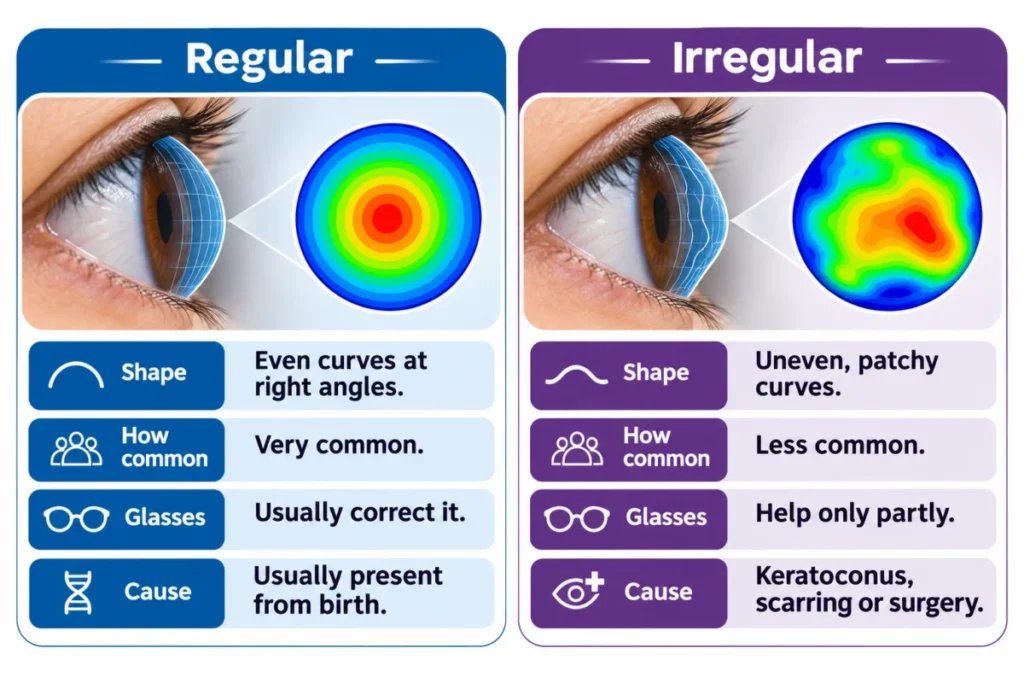
The two types differ in how even that uneven curve is.
| Regular astigmatism | Irregular astigmatism | |
|---|---|---|
| Corneal shape | Steepest and flattest curves at right angles, like a rugby ball | Uneven, patchy curves with no single pattern |
| How common | Very common | Much less common |
| Main causes | Usually present from birth | Keratoconus, scarring, previous eye surgery or injury |
| Glasses | Usually correct it fully | Help only partly |
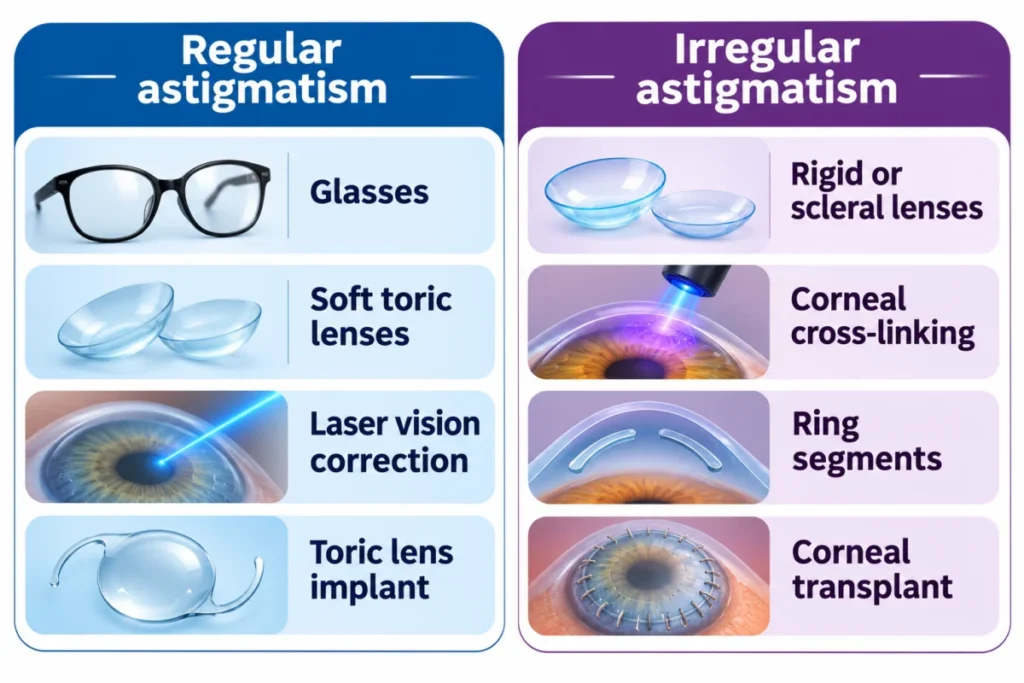
| Typical correction | Glasses, soft toric lenses, laser surgery, toric lens implants | Rigid or scleral lenses, cross-linking, ring segments, transplant |
In regular astigmatism, one cylinder-shaped lens set at one angle can cancel the error. In irregular astigmatism, there is no single axis to correct, which is why glasses stop helping beyond a point.
The key question is whether a simple lens can match the shape of your cornea.
What causes irregular astigmatism?
The most common cause is keratoconus, a condition in which the cornea thins and bulges into a cone shape. It typically begins in the teens or early twenties, and eye rubbing and allergies are linked to it. Astigmatism that keeps getting worse can be an early sign, which is why changing glasses every year deserves a closer look.
Other causes include:
- Scarring after a corneal infection or injury
- A pterygium, a growth of tissue onto the cornea
- Previous corneal surgery, including a corneal transplant
- Rarely, thinning of the cornea after laser vision correction
Picture a 19-year-old college student in New Gurugram whose glasses power keeps rising and whose vision never feels crisp. A corneal scan is the right next step, because early keratoconus can look like ordinary astigmatism. Our page on keratoconus treatment in Gurgaon explains how it is managed.
Rising astigmatism in a young person should always be checked with a corneal scan.
How eye doctors tell them apart
A routine eye test measures how much astigmatism you have, but it cannot always show its shape. For that, doctors use corneal topography or tomography, scans that map the curve and thickness of the cornea.
At Dayal Eye Centre, the Oculus Pentacam maps the front and back surfaces of the cornea in a few seconds, without touching the eye. Regular astigmatism shows a symmetrical “bow-tie” pattern, while keratoconus shows uneven steepening, often below the centre.
Health information on astigmatism notes that astigmatism that gets worse may be a sign of keratoconus. That is why scans are part of every assessment before laser vision correction.
A quick corneal map settles which type you have.
Treatment for each type
Treatment depends on the type, the amount of astigmatism and the health of the cornea.
Regular astigmatism:
- Glasses or soft toric contact lenses usually correct it fully.
- Laser vision correction can reshape the cornea in suitable adults with a stable prescription. Astigmatism treatment in Gurgaon explains the options.
- During cataract surgery, a toric lens implant can correct it at the same time.
Irregular astigmatism:
- Rigid or scleral contact lenses create a smooth new front surface and often give much sharper vision than glasses.
- Corneal cross-linking strengthens the cornea and aims to slow keratoconus while it is still changing.
- Ring segments or a corneal transplant may be considered in advanced cases.
Standard LASIK is generally not suitable for keratoconus, because removing corneal tissue can make the bulging worse. For some irregular corneas that are stable, topography-guided treatment such as Contoura Vision surgery in Gurgaon may be discussed after careful scans.
Our comparison of contoura vision vs lasik explains how the two lasers differ.
Our guide to types of refractive surgery covers other options.
The right treatment starts with knowing which kind of astigmatism you have.
When to get your astigmatism checked
Book an eye examination if your vision is blurred or distorted even with glasses, if your glasses power keeps changing, or if you are considering laser vision correction. Children with astigmatism in one eye should be checked early, because it can affect how vision develops.
Seek in-person eye care straight away for sudden loss of vision or sudden pain and watering in an eye with known keratoconus. Call Dayal Eye Centre on +91 81786 39701 during opening hours, or go to the nearest hospital emergency department.
A changing prescription is a reason for a corneal scan, not just new glasses.
This article is general information. An ophthalmologist needs to examine your eyes to advise on your own case.
Seeing clearly with astigmatism
Regular astigmatism has an even, predictable shape that glasses usually correct, while irregular astigmatism is uneven and often needs special lenses or corneal treatment. A corneal scan tells the two apart. To find out which type you have, book an eye examination at Dayal Eye Centre in Sector 15, Gurugram.
Frequently asked questions
Can regular astigmatism become irregular?
Regular astigmatism does not usually turn irregular. However, early keratoconus can look like regular astigmatism, which is why changing astigmatism needs a scan.
Can glasses correct irregular astigmatism?
Only partly. Rigid or scleral contact lenses usually give clearer vision because they create a smooth new surface.
Is irregular astigmatism serious?
It depends on the cause. Keratoconus needs monitoring and sometimes treatment to slow it, so regular follow-up is important.
Can I have LASIK with astigmatism?
Many people with regular astigmatism are suitable. Those with keratoconus or a thin, irregular cornea usually are not.
Does eye rubbing cause astigmatism?
Rubbing does not cause ordinary astigmatism, but frequent hard rubbing is linked to keratoconus. Treating eye allergies helps.
Can astigmatism get worse with age?
Regular astigmatism usually stays fairly stable. A steady increase, especially in young people, should be checked.
Will a toric lens fix astigmatism during cataract surgery?
It can correct regular astigmatism in suitable eyes. Irregular astigmatism may need other treatment before or after surgery.

Director and Chief Ophthalmologist of Dayal Eye Centre, with more than two decades of experience and over 80,000 cataract surgeries — one of the most experienced eye surgeons in Gurgaon.