




Myopia (short sight) blurs distant objects, while hypermetropia (long sight, also called hyperopia) mainly blurs things up close. Both are refractive errors, which means the eye does not focus light exactly on the retina, the light-sensitive layer at the back of the eye. If you have searched “myopia vs hypermetropia” after an eye test, or wondered whether “hypermyopia” is a condition, you are not alone. This guide explains how the two differ, what causes each, the signs to watch for and how they are corrected.
Myopia vs hypermetropia at a glance
The simplest way to remember the difference is to ask which distance looks clear.
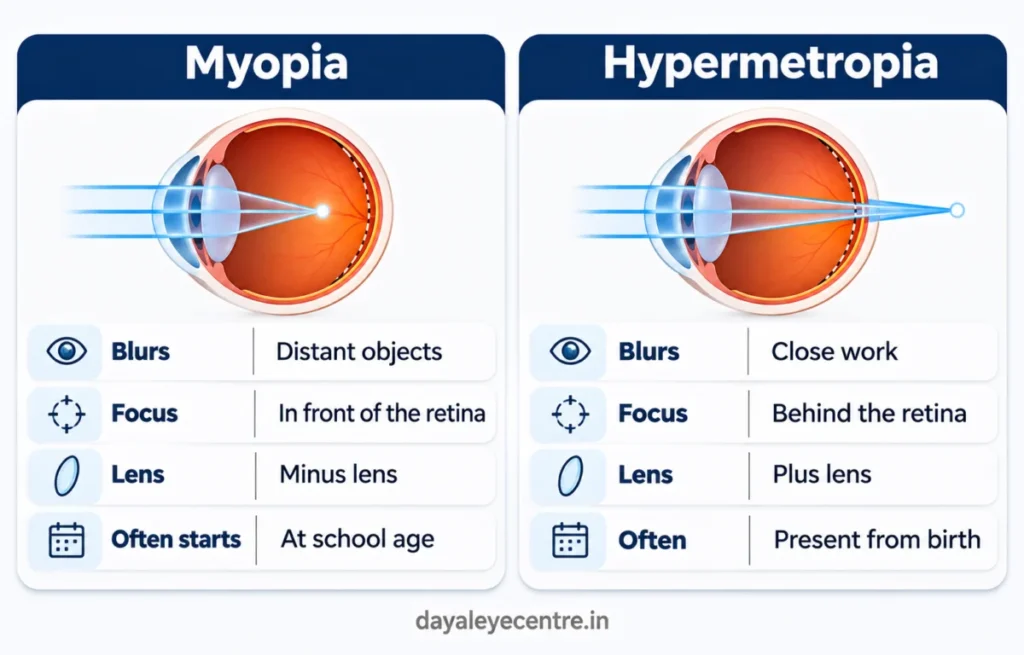
| Myopia (short sight) | Hypermetropia (long sight) | |
|---|---|---|
| What looks blurred | Distant objects, such as road signs or a classroom board | Close objects, such as a phone or book, and sometimes far ones too |
| Where light focuses | In front of the retina | Behind the retina |
| Usual eye shape | Eye slightly too long, or cornea too curved | Eye slightly too short, or focusing too weak |
| Glasses power | Minus (concave) lens | Plus (convex) lens |
| Common onset | School-age children and teens | Often present from birth |
“Hypermyopia” is not a separate condition. It is usually a mix-up of the two words, and an eye test will show which one, if either, you have.
One blurs the distance, the other blurs the near, and a simple test tells them apart.
What causes each one?
Clear vision depends on the length of the eye matching its focusing power. Most of that focusing power comes from the cornea, the clear front window of the eye, with help from the lens inside.
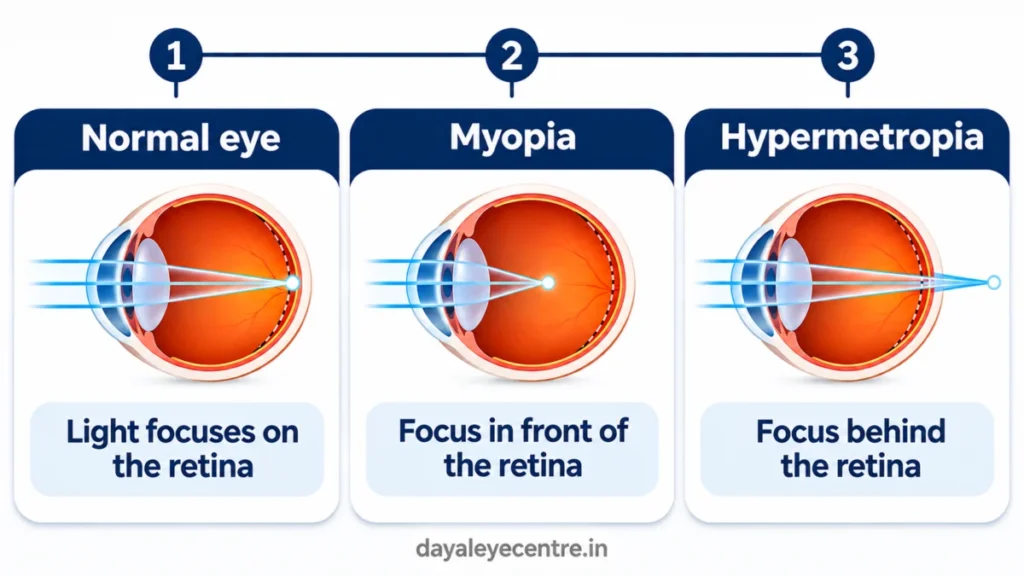
In myopia, the eye is slightly too long or the cornea too steeply curved, so light comes to a point in front of the retina. In hypermetropia, the eye is slightly too short or the focusing power too weak, so the point falls behind the retina. A family history makes both more likely.
The difference comes down to where light focuses inside the eye.
Signs of myopia and hypermetropia
With myopia, you may notice:
- Blurred road signs, scoreboards or the TV from across the room
- Squinting to see distant things more clearly
- Eye strain, and sometimes headaches
With hypermetropia, you may notice:
- Blurred close work, such as reading or phone use
- Tired, aching eyes after reading
- Headaches during long spells of close work
- In children, an eye that turns inward
Mild hypermetropia may cause no symptoms at all, because a young eye can work harder to focus. Strong long sight in one eye is a common hidden cause of lazy eye in children. Our article on hyperopia covers long sight in more detail.
If the same distance keeps looking blurred, an eye test is the quickest answer.
Myopia and hypermetropia in children
Myopia is often first noticed in school-age children and teenagers, who struggle to read the board but read books easily. It tends to worsen during the growth years and usually stops progressing in the early twenties, so glasses may need frequent updates.
Most babies are born slightly long-sighted, and in most children this settles on its own within the first few years. Some children stay strongly long-sighted and need glasses so that their vision develops normally. More time outdoors in childhood may be linked to less myopia.
Our overview of refractive errors covers astigmatism and other focusing problems that often appear alongside.
Regular eye checks through the school years keep both conditions in step with a growing eye.
How they are corrected
Glasses and contact lenses correct both conditions by moving the focus back onto the retina. Myopia uses a minus lens and hypermetropia a plus lens, and the power is measured during an eye test.
For adults with a stable prescription who want to reduce their dependence on glasses, laser surgery reshapes the cornea. LASIK eye surgery in Gurgaon is one option, and suitability depends on corneal thickness, shape and eye health.
Where the cornea is too thin or the power is high, ICL surgery in Gurgaon places a thin lens inside the eye instead. Health information on nearsightedness notes that glasses and contact lenses do not change how myopia progresses, so overly strong prescriptions should be avoided.
Our page on myopia treatment in Gurgaon explains the options for short sight. Not everyone is suitable for surgery, and the right choice depends on a full eye examination.
For long sight, hyperopia treatment in Gurgaon covers glasses, lenses and surgery. Plus-power corrections need especially careful measurement.
Correction is simple for most people, and surgery is a choice rather than a necessity.
Is long sight the same as needing reading glasses?
Not quite. Needing reading glasses after about 40 is called presbyopia, the natural stiffening of the lens with age. It is often called long sight, but it is a different condition from hypermetropia.
People with hypermetropia also develop presbyopia as they age, so they may notice close work becoming harder earlier than friends of the same age. A short-sighted person may find they can read better without their distance glasses after 40.
Hypermetropia is about eye shape, while presbyopia is about age.
This article is general information. An ophthalmologist needs to examine your eyes to advise on your own case. If you are short-sighted and notice sudden flashes, a shower of new floaters or a shadow across your vision, seek in-person eye care straight away. Call Dayal Eye Centre on +91 81786 39701 during opening hours, or go to the nearest hospital emergency department.
Getting your focus right
Myopia blurs the distance and hypermetropia blurs close work, and both are easily measured in an eye test. Glasses or contact lenses correct most cases, and surgery may suit some adults. To find out where your eyes focus, book an eye examination at Dayal Eye Centre in Sector 15, Gurugram.
Frequently asked questions
Can you have myopia in one eye and hypermetropia in the other?
Yes, though it is uncommon. A large difference between the eyes needs checking in children, because it can lead to lazy eye.
Is “hypermyopia” a real condition?
No. It is usually a mix-up of myopia and hypermetropia. Your eye test report will show which one you have.
Which is worse, myopia or hypermetropia?
Neither is simply worse. High myopia carries a higher risk of some retinal problems, while long sight in children can affect how vision develops.
Can myopia be reversed?
Glasses, contact lenses and surgery correct the focus, but they do not change the eye’s length. Regular checks help manage any change.
Does reading in dim light cause myopia?
Reading and screens do not cause myopia on their own. Family history and time spent outdoors in childhood both play a part.
Can children grow out of hypermetropia?
Mild long sight in babies often settles in the first few years. Stronger long sight may need glasses through childhood.
What does a minus or plus number on my prescription mean?
A minus number means short sight, and a plus number means long sight. The larger the number, the stronger the lens.

Director and Chief Ophthalmologist of Dayal Eye Centre, with more than two decades of experience and over 80,000 cataract surgeries — one of the most experienced eye surgeons in Gurgaon.