Astigmatism treatment corrects blurry, distorted or uneven vision and sharpens your overall clarity. Our refractive specialists map your cornea and match the right correction to your eyes — from cylindrical glasses to Contoura Vision, LASIK, SMILE and toric ICL — in an NABH-accredited hospital. Book your evaluation and find the path to clearer vision with less dependence on glasses.
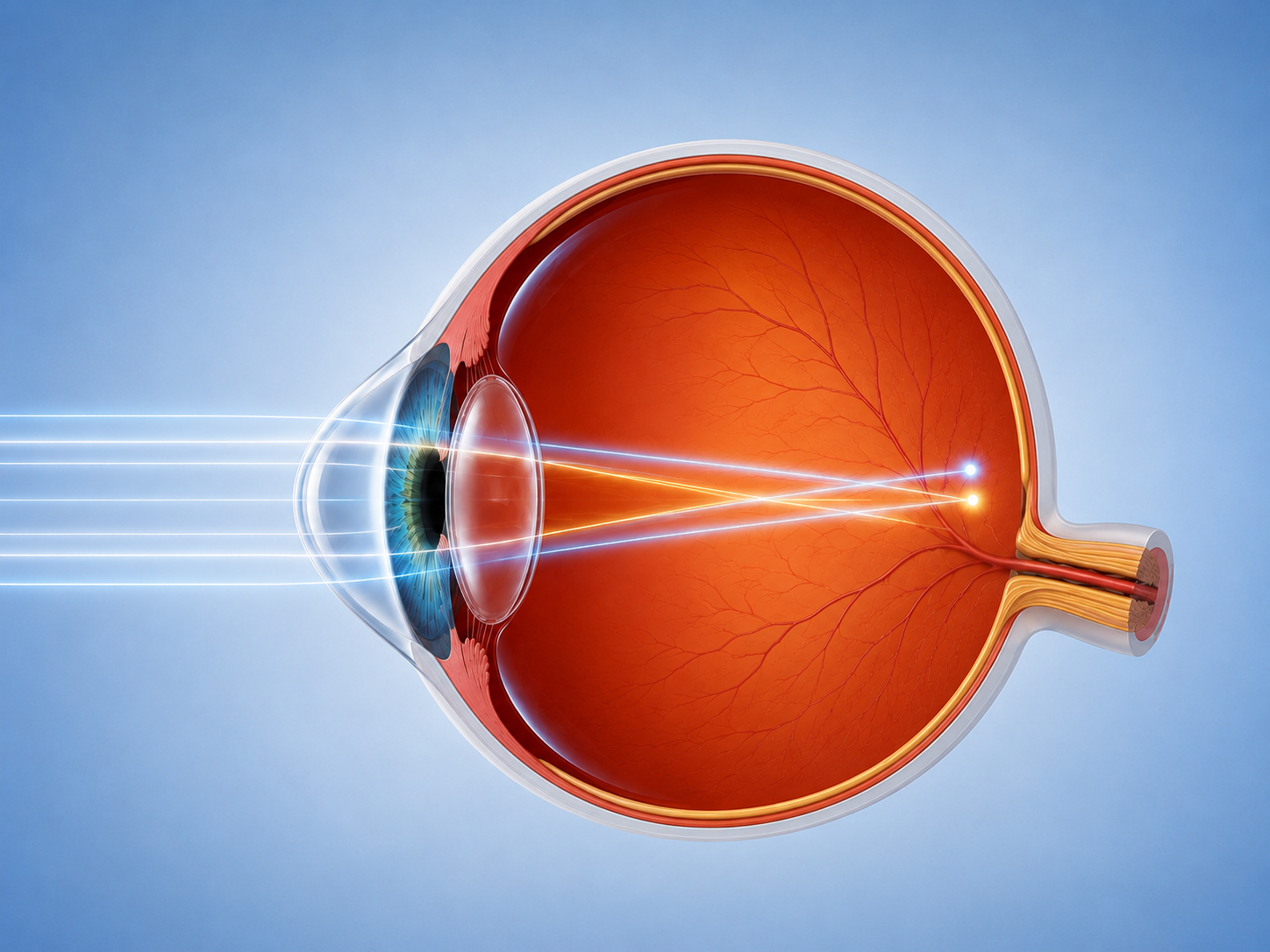
In astigmatism, an unevenly curved cornea focuses light at more than one point
In Short
Astigmatism is a refractive error where the cornea is curved more in one direction than another — shaped a little more like a rugby ball than a football — so light focuses at more than one point. Images can look soft, stretched or slightly doubled at every distance, not just far or near.
It is very common, often present from birth, and frequently sits alongside a nearsighted or farsighted number. It cannot be exercised away — but for most eyes it corrects well, and the right option is chosen after mapping your cornea.
Also Called
Cylindrical power · “CYL” number · Belan-shaped eye number
Specialty
Refractive Services & Cornea
20+
Years of specialist refractive care in Gurgaon
1.2 Lakh+
Surgeries performed at the centre
4
Laser & lens routes under one roof — Contoura, LASIK, SMILE, toric ICL
NABH
Accredited multi-speciality eye hospital
Symptoms
Do These Blurred and Distorted Vision Signs Sound Familiar?
Astigmatism rarely blurs vision only far away or only up close. Because light focuses at more than one point, images can look soft, stretched or slightly doubled at all distances — and many people strain to compensate for years without realising why.
It May Be Worth an Eye Check If You Notice
Blurred or distorted vision at near and far — letters and edges that smear or ghost slightly.
Glare, starbursts and haloes around lights — most obvious driving at night, when headlights flare across the windscreen.
Eye strain, tired eyes or headaches after screens, reading or close work.
Frequent squinting to bring things into focus.
A prescription that already lists a “cylinder” (CYL) and axis value alongside your sphere power.
A family history of astigmatism, or a nearsighted / farsighted number that keeps you in glasses.
When to See a Doctor
A rapidly changing astigmatism can occasionally point to a corneal condition rather than a simple glasses change.
Persistent night-driving glare that no glasses seem to fix.
Vision that no glasses prescription seems to fully sharpen.
A cylinder number that keeps rising at each eye check.
Any sudden distortion of vision — straight lines that begin to look bent.
There is a clear ladder of options — from simple non-surgical correction to laser and lens-based surgery. Because we offer the full range under one roof, our surgeons match the path to your cornea, your power and your lifestyle rather than fitting every eye to a single method. Your evaluation confirms what is right for you.
Non-surgical
Glasses (Cylindrical / Toric)
Lenses ground to offset the cornea’s uneven curve. The simplest, safest correction and the first line for almost every eye.
Who it may suit:Any age; children and anyone not seeking surgery
Non-surgical
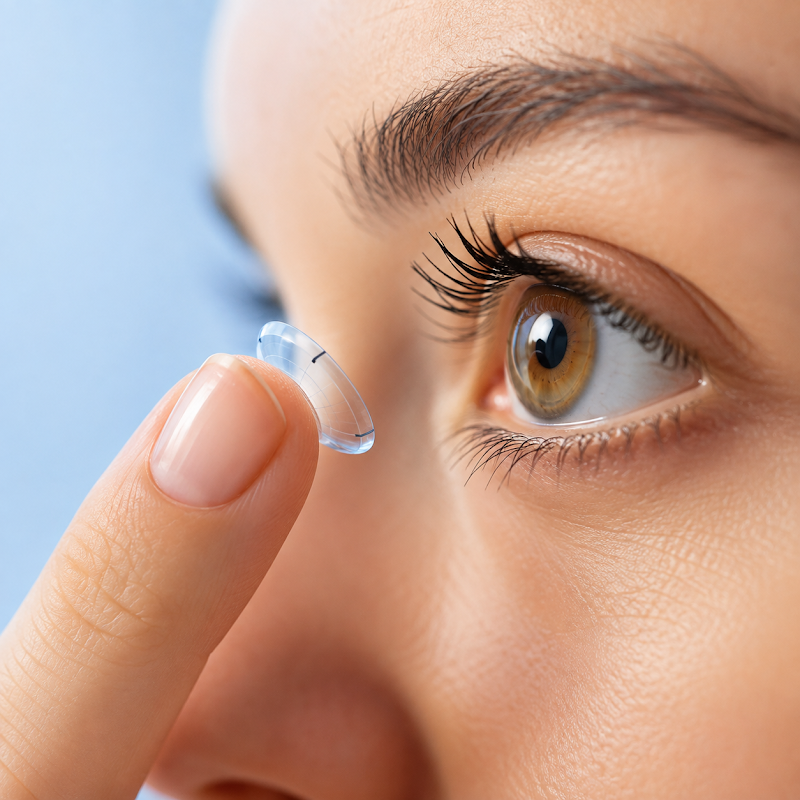
Toric Contact Lenses
Soft or rigid lenses designed to correct the cylinder, stabilised to sit at the right axis on the eye. A wider field of view than glasses.
Who it may suit:Those comfortable with lenses, or wanting a non-surgical option
Surgical · Topography-guided
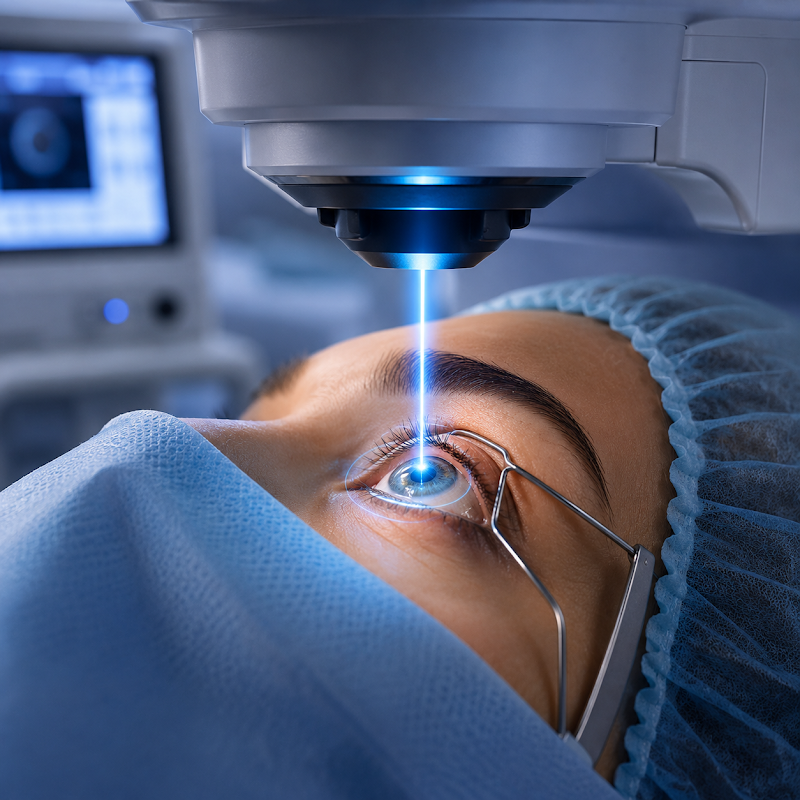
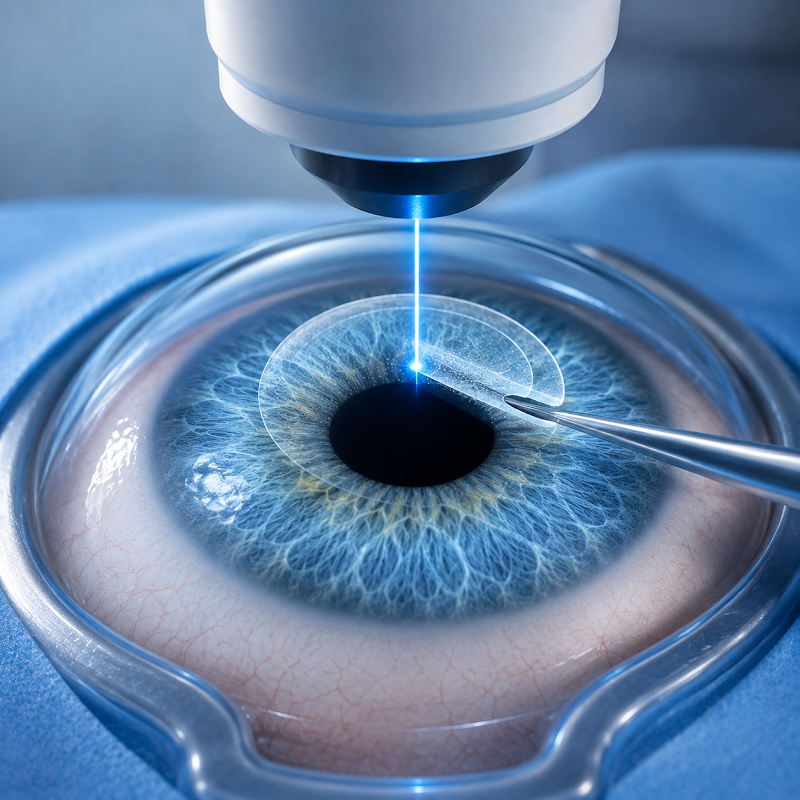
Contoura Vision
Maps thousands of elevation points on the cornea and treats its uneven curve point by point — particularly well matched to astigmatic corneas.
Who it may suit:Regular astigmatism with adequate corneal thickness
Astigmatism is where topography-guided treatment earns its keep: because Contoura Vision builds its plan from thousands of measured elevation points on your cornea, it is particularly well matched to astigmatic corneas, where the irregular curve is the whole problem. Where powers are high or corneas thin, a toric ICL corrects the cylinder without reshaping the cornea — and for patients having cataract surgery, toric IOLs can correct astigmatism at the same time. If you would like the background first, read our guide on astigmatism causes, diagnosis and treatment.
Not everyone is a candidate for every option. Suitability, benefits and risks depend on your prescription, corneal thickness and shape, age and overall eye health, and can only be determined after a detailed evaluation with our doctors.
Diagnosis
How Do We Decide Which Path Suits Your Eyes?
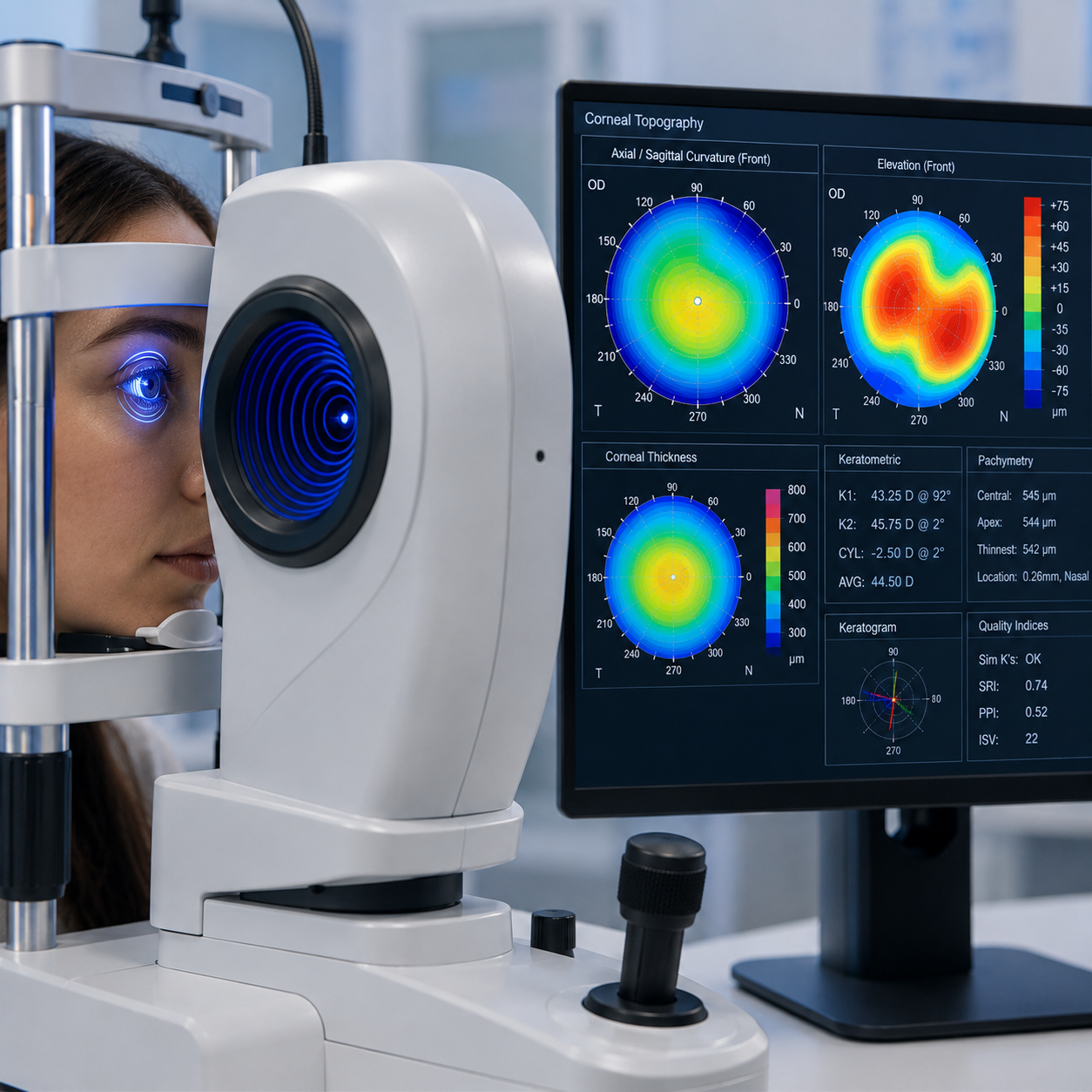
Astigmatism planning lives or dies on accurate measurement, so mapping the cornea is central to how we decide. On the OCULUS Pentacam we build a detailed tomography map of your cornea’s front and back curves and its thickness; the iTRACE adds ray-tracing aberrometry that shows exactly how light is being distorted as it passes through your eye.
Candidacy screening follows the same principles regulators highlight for laser vision correction — a stable prescription, adequate corneal tissue and healthy eyes. If surgery is not the safest choice for your eyes, we will tell you honestly and guide you toward glasses, toric contact lenses or another option.
OCULUS Pentacam
A detailed tomography map of the cornea’s front and back curves and its thickness — the back surface is where the earliest signs of keratoconus appear.
Is your astigmatism regular or irregular? Is the cornea thick and healthy enough for laser? And how much cylindrical power do you have, and is it stable?
Why the Map Matters
Regular vs Irregular Astigmatism: When It Points to Keratoconus
The shape of the unevenness changes the plan entirely — which is why every astigmatism work-up here includes corneal tomography before any surgery is discussed.
More common
Regular Astigmatism
The cornea’s curve is uneven but smooth and symmetrical, like a rugby ball. It corrects predictably with cylindrical glasses, toric lenses or laser treatment — the great majority of astigmatism falls here.
Needs careful screening
Irregular Astigmatism
The surface is uneven in a non-symmetrical way, so no single axis of correction fully sharpens vision and glasses never quite seem right. The most important cause to rule out is keratoconus — a progressive thinning and steepening of the cornea.
The Keratoconus Pathway
Keratoconus often first shows up as astigmatism that keeps rising at every check. This is exactly what Pentacam tomography is designed to detect — it maps the back surface of the cornea, where the earliest changes appear. If keratoconus is found, laser reshaping is generally unsuitable and the priority becomes stabilising the cornea, often with corneal cross-linking (CXL), alongside specialised contact-lens fitting for vision. Our cornea specialist, Dr. Hem Shah, manages this pathway in-house.
Outcomes
Can Astigmatism Be Corrected Permanently With Surgery?
For suitable patients with regular astigmatism, laser vision correction reshapes the cornea to neutralise the cylinder, and the result is long-lasting and stable in most eyes. Published outcomes for laser vision correction in well-selected patients are strong — the American Academy of Ophthalmology notes that about 9 in 10 LASIK patients achieve 20/20 to 20/40 vision without glasses.
It would not be right to promise a fixed outcome for anyone, though — which is why the pre-operative evaluation is so thorough, and why we set realistic expectations before anything is planned.
Individual results and recovery vary based on your eye condition, prescription, corneal thickness, age, overall eye health and healing response. Suitability depends on a detailed evaluation, and not everyone qualifies for laser or lens-based correction.
A Few Honest Points
A small amount of residual power can remain after surgery, and in some eyes part of the number gradually returns over time (regression); published enhancement rates are below 1% at large centres.
Irregular astigmatism — for example from keratoconus — is managed rather than simply corrected.
As with all eyes, age-related near blur (presbyopia) can still develop later in life, so reading glasses may be needed with age.
All surgery carries some risk, which your surgeon will discuss with you in full before anything is planned.
Cost
What Does Astigmatism Treatment Cost in Gurgaon?
There is no single flat price, because it depends on how much cylindrical power you have, whether it comes with a nearsighted or farsighted number, and which technique suits your cornea. Glasses and toric contact lenses are the most economical route.
Each procedure page — LASIK, Contoura Vision and SMILE — carries its own clear, starting-from range, and our refractive surgery cost page brings the indicative ranges together. Every figure is starting-from and subject to an individual consultation; toric ICL pricing is confirmed case by case.
Because astigmatism correction is usually elective, insurance cover is generally limited — but we make planning easier with Easy EMI options and clear, up-front costing.
Get a Costing That Fits Your Eyes
Your exact cost is confirmed only after an examination. Consult our doctors for a clear, personalised estimate and to discuss Easy EMI options.
Why Choose Dayal Eye Centre for Astigmatism Treatment in Gurgaon?
NABH-accredited hospital — three modular operation theatres and an in-patient ward — quality and safety you can verify.
Precise corneal mapping — the OCULUS Pentacam and iTRACE, so astigmatism is measured and planned in detail, not estimated.
The full ladder under one roof — Contoura, LASIK, SMILE and toric ICL — so the technique is matched to your eyes, not the other way around.
A safe pathway for irregular corneas — keratoconus screening on every work-up, with cross-linking and specialist cornea care in-house.
A trusted track record — 1.2 lakh+ surgeries, 20+ years of experience, and recognition including the Ayushman Bharat Awards (2021 & 2024).
Specialist-Led Care
Dr. Sanjeev Bisla
Director & Chief Ophthalmologist · Phaco, Refractive & Glaucoma
23+ years and 80,000+ cataract surgeries, Aravind-trained — supported by cornea & refractive surgeon Dr. Hem Shah, so both the surgical and corneal sides of astigmatism are covered.
The questions patients ask us most. For anything specific to your eyes, a consultation gives the clearest answer.
Astigmatism usually comes from a cornea (the clear front window of the eye) that is curved more in one direction than another, so light focuses at more than one point and vision looks blurred or distorted. It is very common, often present from birth, and can run in families. In some cases it relates to the lens inside the eye or to a corneal condition such as keratoconus, which is why corneal mapping is part of our assessment.
An unevenly curved cornea scatters light instead of focusing it at a single point, and the effect is most noticeable in low light with bright sources — headlights, streetlights, signboards. Night-driving glare, starbursts and haloes are classic astigmatism symptoms, and correcting the cylinder usually improves them. An examination confirms whether astigmatism, dry eye or another cause is responsible.
For most people, cylindrical (toric) glasses or toric contact lenses correct regular astigmatism well and are a sensible first line at any age. Some patients still prefer a glasses-light option, and laser or lens-based correction can reduce dependence on glasses for suitable eyes. A detailed evaluation tells us how well each option is likely to work for you.
In many people astigmatism stays fairly stable, though it can change gradually with age. A noticeable or rapid increase in cylindrical power is worth checking, as it can occasionally point to a corneal condition such as keratoconus. Regular eye examinations let us track any change and advise you accordingly.
It depends on your eyes. Topography-guided Contoura Vision and LASIK suit many patients with regular astigmatism and healthy corneas, while SMILE suits myopic astigmatism, especially in dry-eye-prone or active patients. Where powers are high or corneas are thin, a toric ICL / phakic IOL may be the safer route. Our surgeons recommend a path only after mapping your cornea.
Yes. Astigmatism very often occurs together with myopia or hyperopia, and the same laser or lens-based procedures are designed to correct the cylindrical power and the sphere power together in one treatment. Your surgeon confirms the plan for your specific prescription at consultation.
Children with astigmatism are usually corrected with glasses, as clear focus is important for visual development, and laser surgery is not performed until the eyes are mature and the number is stable — generally 18 years or older. If your child has astigmatism, a paediatric eye assessment guides the right care at the right age.
Glasses and toric contact lenses are the most economical option; laser and lens-based procedures carry clear starting-from ranges on their own pages and on our refractive surgery cost page, always subject to an individual consultation and eye examination. Ask us about Easy EMI and cashless options at your visit.
Take the first step toward sharper, glasses-light vision. Our team will map your cornea, assess your candidacy, explain your options and answer every question — with no pressure to proceed.
 Vision Correction
 Cataract
 Retina
 Glaucoma & Cornea
 Paediatric & Speciality
 Oculoplasty