Dayal Eye Centre is empanelled with CGHS, ECHS, Ayushman Bharat (PM-JAY) and the Health Department, Government of Haryana, and works cashless with more than twenty insurers and TPAs. Our billing team handles the pre-authorisation paperwork for you. See the full list of insurers and schemes.
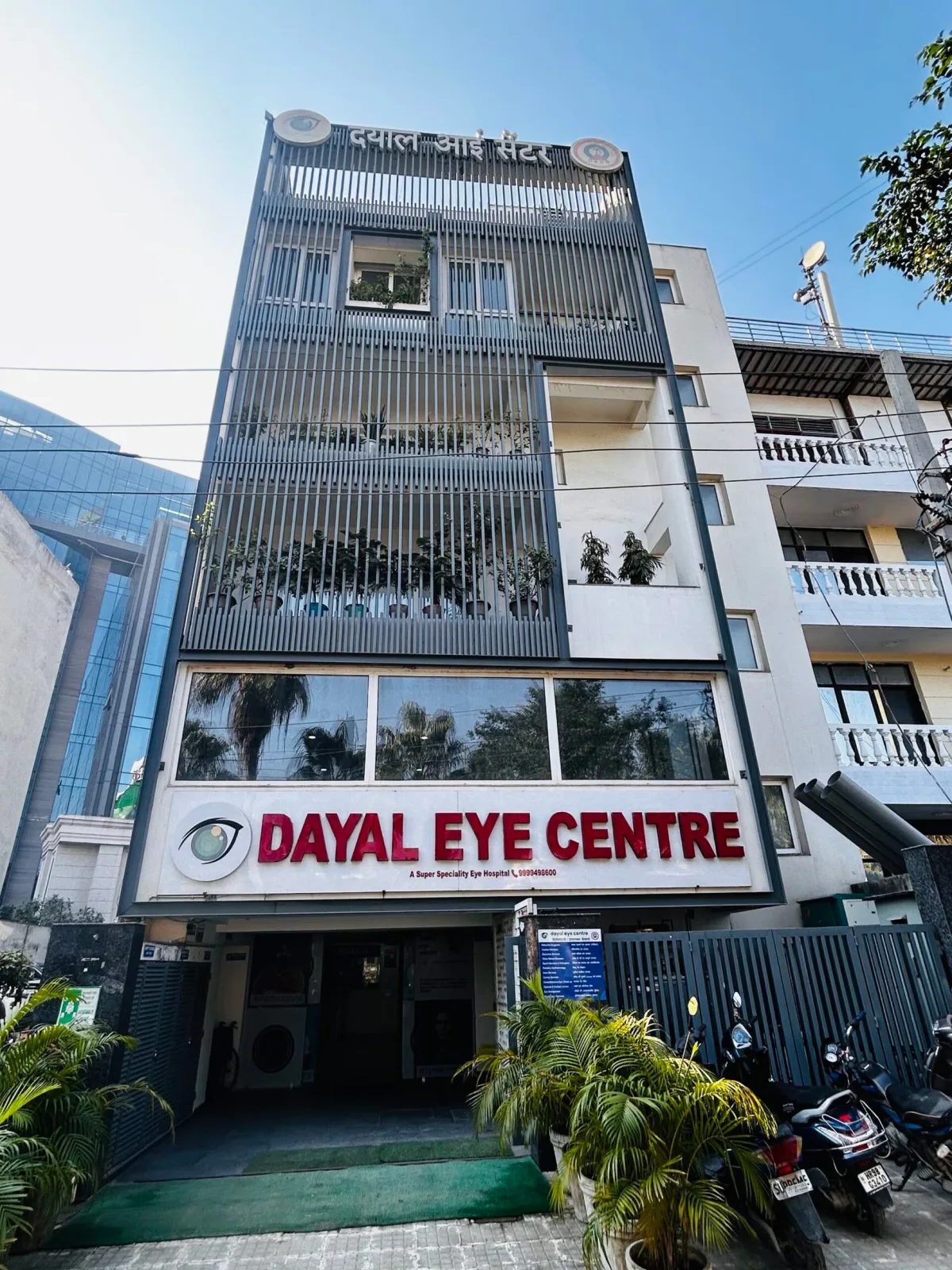
\nOur motto is simple: you and your eyes are our top priority. Dayal Eye Centre is a dedicated eye hospital — eyes are not one department among many here, they are the only thing we do. That focus lets a patient be examined, counselled, operated and followed up by the same senior team, on one site, with the diagnostics, the femtosecond laser and the operation theatres in the same building.

Independently assessed against national standards for clinical quality and patient safety, with three modular operation theatres and an in-patient ward for the small number of cataract patients who need to stay.
Every modern cataract pathway under one roof — your measurements decide which one suits your eye.
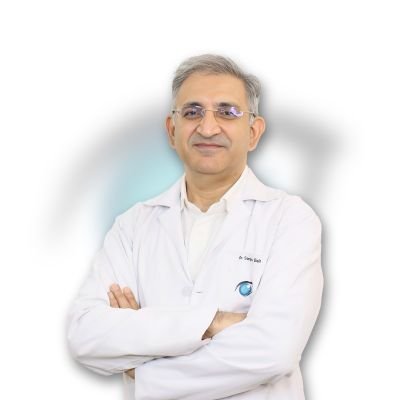
Led by our Director, with fellowship-trained cataract surgeons — the doctor who examines you is the doctor who operates.
These are our own patients, in their own words.
Testimonials reflect the personal experience of individual patients and are shared with consent, initials only. Individual results vary with age, eye health, the type of cataract and the lens implanted, and adherence to post-operative care. These testimonials are not medical advice.
Your pre-FLACS work-up — six checks we complete before the laser is offered, so the recommendation is about your eye, not the equipment.
A femtosecond laser delivers pulses lasting a quadrillionth of a second. At that speed the energy separates tissue at a precisely chosen depth without generating heat in the tissue around it. It is the same class of laser used to create the corneal flap in Femto LASIK — applied here to the front of the eye and the lens inside it.
The important thing to understand is what FLACS is not: it is not a laser that dissolves your cataract and replaces the surgery. The cataract is still removed by phacoemulsification — ultrasound energy, through a small incision — and the intraocular lens is still implanted by the surgeon.
FLACS automates the opening moves, not the operation.
Everything after these three steps is performed by the surgeon, exactly as in conventional surgery.
In conventional surgery the surgeon makes these with a fine blade. The laser makes them to a pre-planned length, depth, architecture and position. Where a patient has low corneal astigmatism, the same laser can also place precise arcuate relaxing incisions to reduce it.
In conventional surgery this is a free-hand circular tear (capsulorhexis), and it is one of the most skill-dependent steps in all of ophthalmic surgery. The laser cuts a perfect circle of a chosen diameter, centred on a chosen point. This is FLACS’s clearest technical advantage: a capsulotomy that is reproducibly round, sized and centred.
The laser pre-divides the cataract into segments and softens it before the phaco probe is introduced. Because the lens arrives pre-fragmented, less ultrasound energy is needed to remove it — measured as reduced effective phaco time.
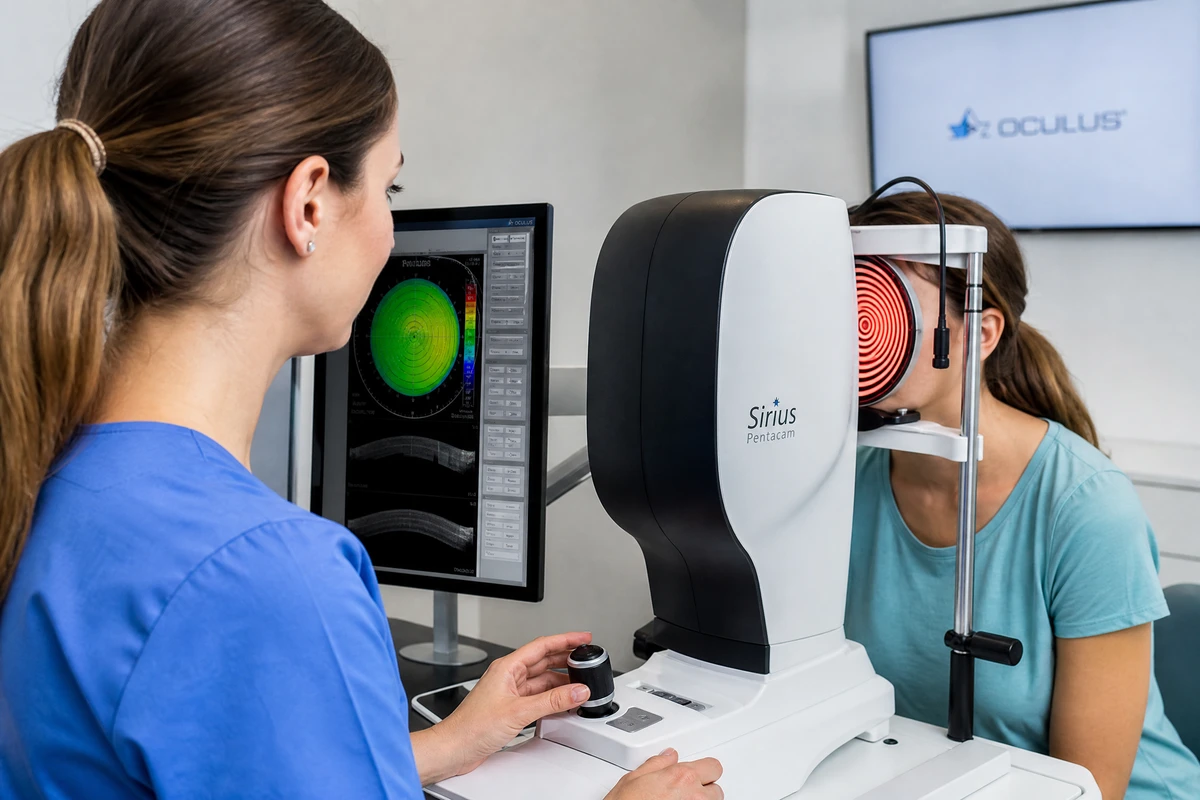
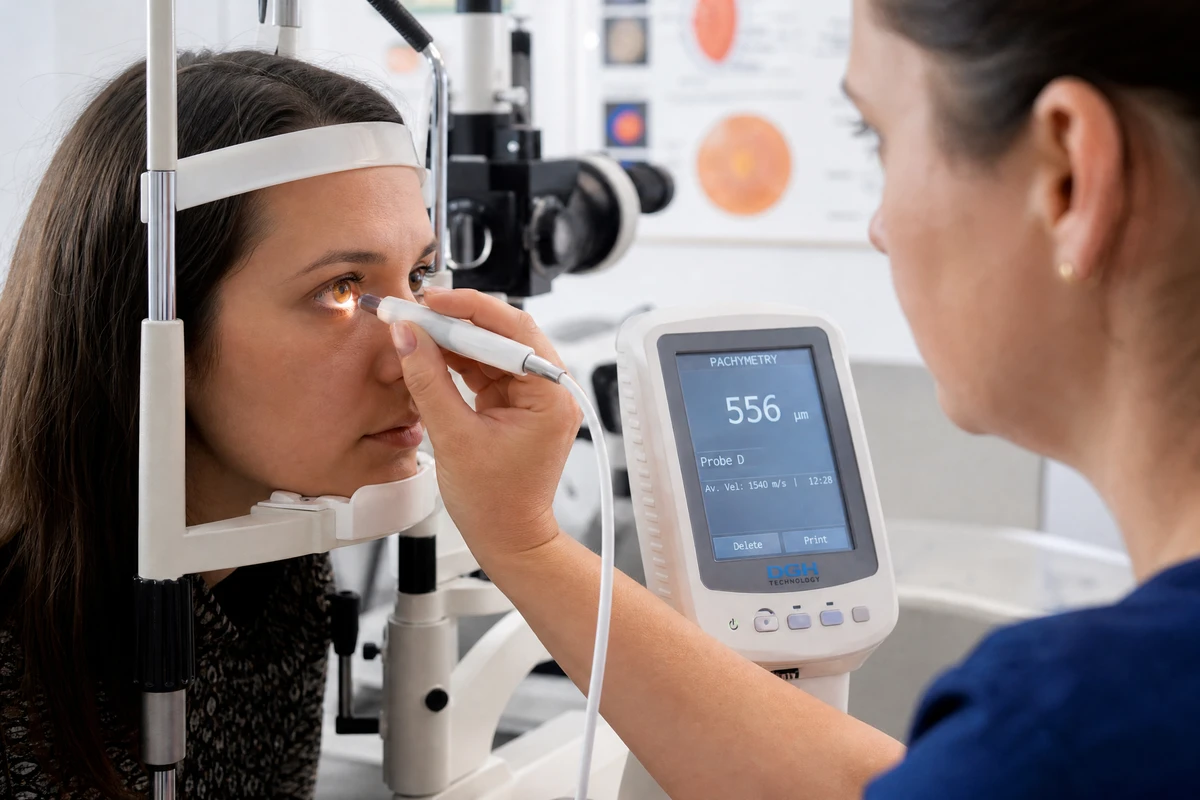
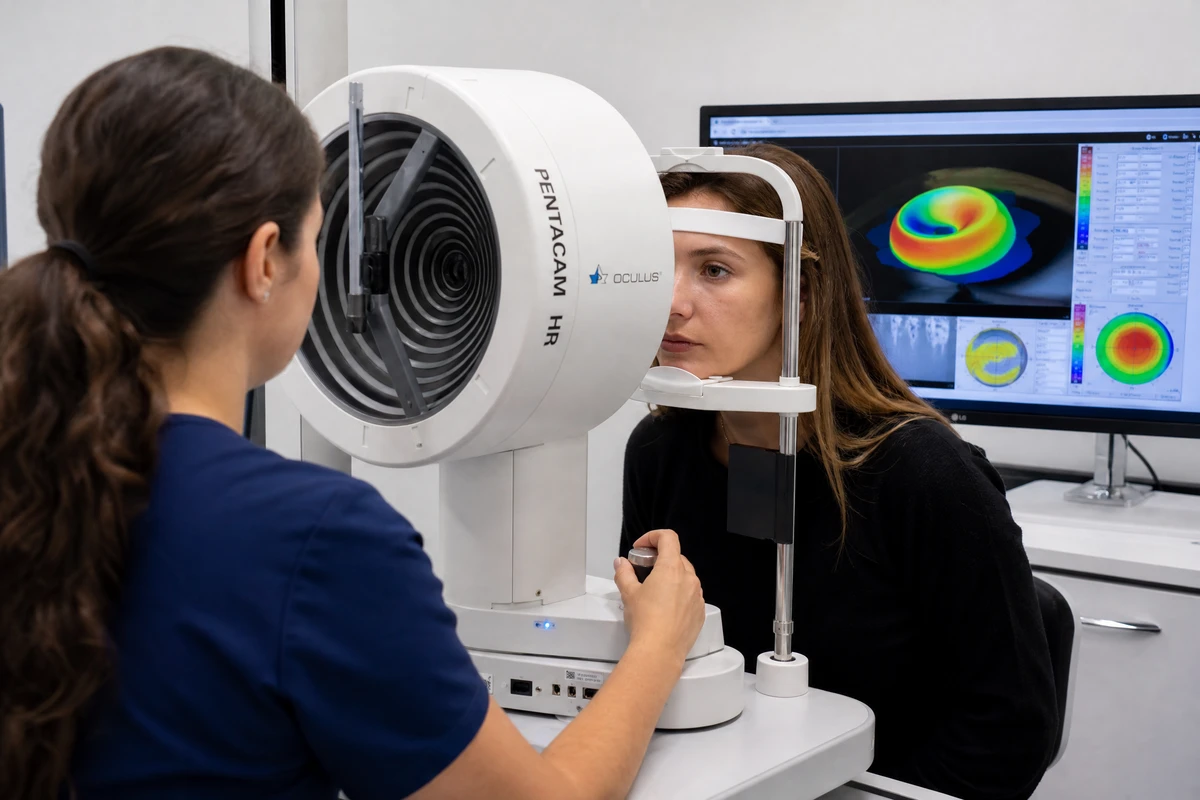
Before the day. The same assessment as any cataract surgery here: optical biometry on the Zeiss IOL Master 700, corneal tomography on the OCULUS Pentacam, iTRACE ray-tracing aberrometry, a dilated retinal examination with OCT, tonometry, and blood pressure and blood sugar checks. The IOL is chosen from these measurements.
More on our pre-operative assessmentBoth stages are completed in one sitting. It is day care — you go home the same day.
Anaesthetic drops are given. A patient interface gently couples the laser to the eye, and the system images the eye and builds a three-dimensional map of the cornea, the anterior chamber and the lens.
The surgeon reviews and approves the treatment plan on screen — the incision positions, the capsulotomy diameter and centration, and the fragmentation pattern — and only then are the laser pulses delivered. This stage takes a matter of minutes, and you will be aware of pressure rather than pain.
You are moved to the operating microscope. The surgeon opens the laser-made incisions, removes the free capsulotomy disc, emulsifies and aspirates the pre-fragmented cataract, clears the capsular bag, and implants the foldable IOL through the same incision.
Intracameral antibiotic prophylaxis is given, the wound is sealed, and a shield is applied. Everything the laser does not perform — clearing the capsular bag, positioning the lens, managing anything unexpected — is the surgeon’s, exactly as in conventional surgery.
This is the section most FLACS pages skip. We would rather you read it here than find it somewhere else after you have paid.
These are the advantages that are real and measurable.
A reproducibly round, sized and centred capsulotomy. A laser circle is more consistent than a free-hand tear. Where an IOL’s optical performance depends on the capsule overlapping its edge evenly — as with some premium lenses — that consistency has a rational basis.
Bladeless corneal incisions, cut to a planned architecture and depth.
Less ultrasound energy inside the eye. The pre-fragmented lens needs less effective phaco time, which in principle means less energy delivered near the corneal endothelium.
Precise arcuate incisions for low astigmatism, planned on the corneal map rather than judged by hand.
A slightly faster early visual recovery. A 2025 meta-analysis of 46 randomised trials (8,871 eyes) found FLACS gave significantly better corrected distance visual acuity at one week (p = 0.011).
Four independent, high-quality evidence sources — two systematic reviews and two large randomised trials — point the same way.
No significant difference at any timepoint beyond one week — not in corrected distance visual acuity, not in uncorrected distance visual acuity, not in spherical equivalent, not in surgically induced astigmatism, and not in overall complications. Its conclusion, verbatim: “both techniques yielded comparable extended-term results encompassing visual outcomes, surgical efficacy, complications, and patient-reported outcomes.”
Concluded: “there is probably little or no difference between FLACS and PCS in terms of intraoperative and postoperative complications, postoperative visual acuity and quality of life.” It added that evidence from two studies suggests FLACS may be the less cost-effective option.
Success rates were 41.1% with FLACS and 43.6% with conventional phacoemulsification — no significant difference (adjusted odds ratio 0.85, 95% CI 0.64–1.12). The authors’ conclusion: “Despite its advanced technology, femtosecond laser was not superior to phacoemulsification in cataract surgery and, with higher costs, did not provide an additional benefit over phacoemulsification for patients or health-care systems.”
Found FLACS non-inferior — that is, as good, not better — at three months for vision, patient-reported health and safety.
We are not going to pretend otherwise. Here is what we take from it.
If someone tells you the laser will make you see better than conventional surgery would, ask them for the trial. There isn’t one.
The laser’s advantage is consistency of execution in the opening steps. There are eyes where that consistency is worth having — a dense cataract where reducing ultrasound energy matters, a compromised corneal endothelium, a premium lens whose centration depends on a precise capsulotomy, a patient in whom a free-hand capsulorhexis would be technically demanding. In those eyes we will recommend it, and we will tell you which of those reasons applies to you.
That is not us talking you out of spending money. It is the reason we publish the trials.
The steps the laser does not perform — clearing the capsular bag, implanting and positioning the lens, managing anything unexpected — are still the surgeon’s, in FLACS exactly as in conventional surgery.
We would discuss FLACS with you where one or more of these applies — and we will tell you which one applies to your eye.
A dense or hard cataract, where pre-fragmenting the lens meaningfully reduces the ultrasound energy needed to remove it.
A compromised corneal endothelium — a low cell count, Fuchs’ dystrophy or previous corneal disease — where reducing energy near that cell layer matters. Assessed with our cornea service.
A premium intraocular lens — particularly multifocal, trifocal or toric — where a precisely sized and centred capsulotomy supports stable lens position.
Low corneal astigmatism that can be addressed with laser arcuate incisions rather than a toric lens.
A patient who, having read the evidence above, still prefers a bladeless procedure. That is a legitimate preference, and we will perform it.
Corneal endothelial health is assessed with our cornea service before a laser-assisted procedure is planned.
Yes — FLACS is compatible with every category of IOL, and the argument for pairing them is the strongest rational case for the technology.
Multifocal and trifocal lenses split incoming light between focal points. That optical design assumes the lens sits centred and stable in the capsular bag, and a capsulotomy of consistent diameter and centration is what holds it there. Toric lenses have to be rotated to a precise axis and stay on it. A predictable capsule opening supports both.
The trade-off inherent in the lens itself. The Cochrane review of 20 randomised trials (2,061 people, 3,194 eyes) found multifocal IOLs reduce spectacle dependence but make halos around three and a half times more common and glare around 1.4 times more common than monofocal lenses — and no surgical technique alters that.
The reviewers’ conclusion holds either way: “Motivation to achieve spectacle independence is likely to be the deciding factor.”
Recovery after FLACS follows the same course as conventional cataract surgery — the incision size and the healing process are equivalent.
Most patients begin to see within a few hours, since the eye is not routinely padded. Grittiness, watering and mild redness in the first days are normal.
The eye-drop schedule runs about four weeks and is the single most important thing you do. No rubbing the eye; shield at night; no bending, straining or heavy lifting for the first few days; no water on the face for a week.
Normal diet from the day of surgery. Shaving, walks and driving from around day three, once confirmed at follow-up.
Kitchen work from about a week. Head bath after a week rather than water on the face earlier.
Screens and television within one to two weeks; yoga and gym from two to three weeks.
Full healing takes around four weeks, and spectacles, if needed, are prescribed four to six weeks after the final surgery.
Call us immediately — do not wait for your next appointment — for increasing pain, a sudden loss of vision, spreading redness or discharge. +91 81786 39701.
Individual recovery varies with age, eye health, cataract density, the lens implanted and adherence to post-operative care.
FLACS carries every risk that conventional cataract surgery carries, because the phacoemulsification stage is the same operation — endophthalmitis (around 0.045%, roughly 1 in 2,200, where intracameral prophylaxis is used), posterior capsule tear, corneal oedema, raised intraocular pressure, cystoid macular oedema, posterior capsule opacification months to years later, retinal detachment, and residual refractive error.
The 2023 Cochrane review and the 2025 meta-analysis both found no significant difference in overall complications between FLACS and conventional phacoemulsification.
A page selling you FLACS ought to name these. They are uncommon, and they are managed.
Suction loss or docking difficulty, requiring the laser stage to be repeated or abandoned and the surgery completed conventionally.
Subconjunctival haemorrhage — a red patch on the white of the eye from the suction ring. Cosmetic, harmless, and it clears in a couple of weeks.
Pupil constriction during the laser stage (miosis), which can make the phaco stage more demanding.
An incomplete capsulotomy, needing to be completed by hand.
Anterior capsule tags or tears at the capsulotomy edge.
Transient rise in intraocular pressure during docking.
They are listed because informed consent means knowing them before, not after.
All surgical procedures carry inherent risks, including infection, bleeding, and rarely, loss of vision. Not every patient is a suitable candidate for every procedure. Your surgeon will discuss the risks and benefits that apply to your eye during your consultation.
Femtosecond laser-assisted cataract surgery carries an additional charge over conventional phacoemulsification, reflecting the laser platform and the single-use patient interface. As with any cataract surgery, the intraocular lens you choose affects the total more than the surgical technique does.
FLACS costs more than conventional phacoemulsification at Dayal Eye Centre. The exact difference depends on the lens chosen and on what your eye needs, and we will give you an itemised estimate at your consultation — before you commit to anything. Cashless insurance, government schemes and Easy EMI apply to cataract surgery here, and our billing team will tell you what your policy covers for a laser-assisted procedure.
Most policies cover cataract surgery as a medically necessary procedure, but the additional charge for laser assistance and for premium lenses is often treated as an elective upgrade and may not be reimbursed in full. Ask us to check your specific policy before you decide — that is a conversation to have in advance, not at discharge.
Prices shown are approximate and may vary based on individual patient needs, complexity of case, and procedures performed. Final pricing will be determined after a complete consultation and examination. Prices do not include any additional tests or treatments that may be medically necessary. Insurance coverage varies by plan. They are not a quotation.
A centre that only owns a femtosecond platform has an incentive to recommend it. We perform high volumes of conventional phacoemulsification as well, which means the recommendation you get is about your eye.
Including the part that does not sell the laser. You will not find the FEMCAT and Cochrane findings on many FLACS pages in Gurgaon. You have just read them on ours.
80,000+ cataract surgeries by our Director; 1.2 lakh+ eye surgeries across the centre in 20+ years. The phacoemulsification stage is still the operation, and it is still done by hand.
IOL Master 700, Pentacam, iTRACE, OCT — all on site, all before the lens is chosen.
Three modular operation theatres and an in-patient ward on site.
Government schemes and Easy EMI, with the paperwork handled by our team.
Zeiss IOL Master 700 optical biometry · OCULUS Pentacam corneal tomography · iTRACE ray-tracing aberrometry · RTVue FD-OCT macular imaging. All on site, all before the lens is chosen.
Reviewed by Dr. Sanjeev Bisla, MS (Ophthalmology), Director & Chief Ophthalmologist — Dayal Eye Centre · Last reviewed: 28 July 2026 · Editorial Policy
This page is for information only. It is not medical advice, a diagnosis or a treatment plan. Individual results vary. To find out what applies to your eyes, consult with our doctors at Dayal Eye Centre.