







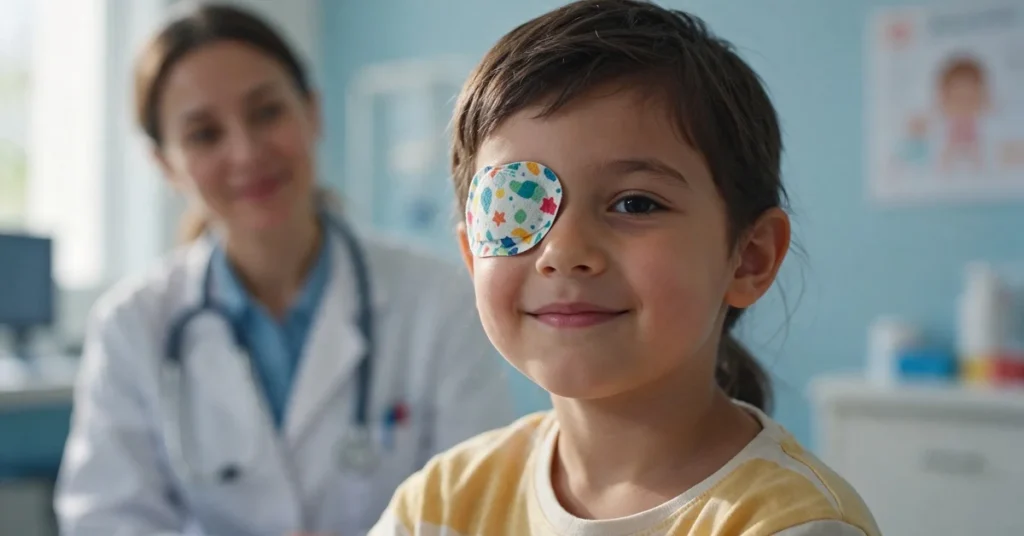
Lazy eye, or amblyopia, is reduced vision in one eye that develops in childhood because the brain learns to rely on the stronger eye. The eye itself may look normal, which is why many parents only find out at a school screening. If you have been told your child may need lazy eye treatment, it is natural to worry about patches, glasses and whether the vision will improve. This guide explains the signs to look for, how lazy eye is diagnosed and treated, and why the timing matters.
What is lazy eye?
In the first years of life, the eyes and brain learn to work together. If one eye sends a blurred or misaligned picture, the brain starts to ignore it, and that eye’s vision stops developing normally.
Lazy eye is the most common cause of vision problems in children. It usually affects one eye, although it can rarely affect both. Glasses alone do not always restore full sight, because the problem lies in how the brain processes the picture.
Lazy eye is a vision development problem, not a weak eye muscle.
What causes lazy eye?
There are three main causes, and some children have more than one:
- A squint. When one eye turns in or out, the brain ignores the image from that eye to avoid double vision. This is the most common cause.
- Unequal focusing power. If one eye has much more short sight, long sight or astigmatism than the other, the brain favours the clearer eye.
- Something blocking vision. A cataract or a droopy eyelid present in early childhood can stop light reaching the back of the eye clearly.
Children born early, those with a low birth weight and those with a family history of squint or lazy eye are more likely to have it. Strong hyperopia, or long sight, in one or both eyes is a common hidden cause.
Finding the cause guides every step of treatment.
Signs parents can spot
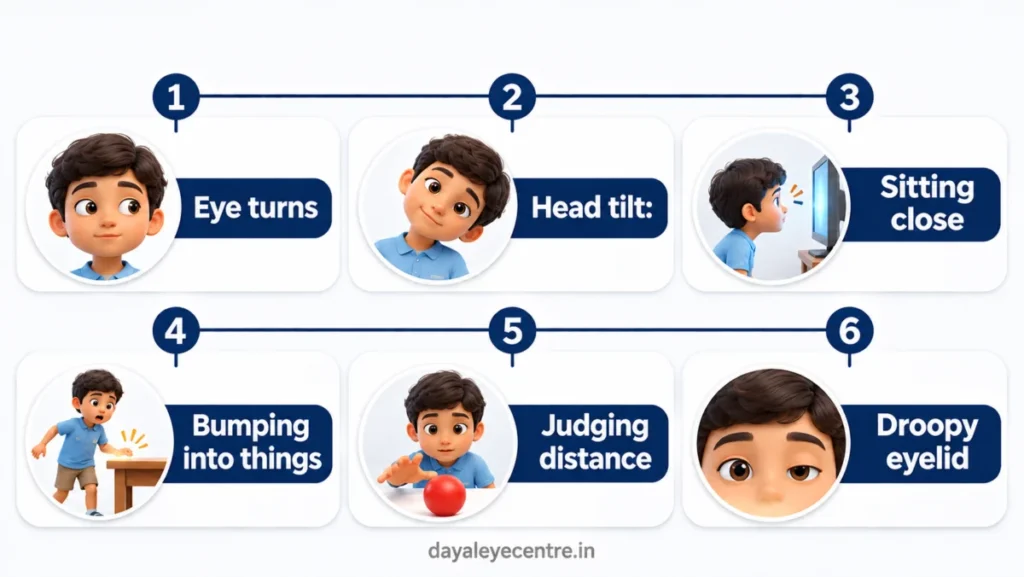
Young children rarely say that one eye sees less well, because the brain simply uses the better eye. Watch for:
- One eye that turns in, out, up or down
- Tilting the head or closing one eye to look at things
- Squinting, or sitting very close to the TV or a book
- Bumping into things on one side
- Trouble with catching a ball or judging distance
- A droopy eyelid on one side
Picture a four-year-old in Palam Vihar who always covers one eye while watching cartoons. It looks like a habit, but it can be the brain’s way of avoiding a blurred or double picture.
Small habits can be the only clue, so trust your instinct and ask for a check.
How lazy eye is diagnosed
Lazy eye is usually found during a complete eye examination. The doctor checks vision in each eye separately, using pictures or letters that suit the child’s age.
Eye drops are often used to relax the focusing muscles so the true glasses power can be measured. The doctor also checks how the eyes move together and looks inside the eye for any blockage such as a cataract. Our paediatric ophthalmology in Gurgaon team plans these tests around young children, with short steps and breaks.
A full check needs no special preparation, only a little patience on the day.
Lazy eye treatment, step by step
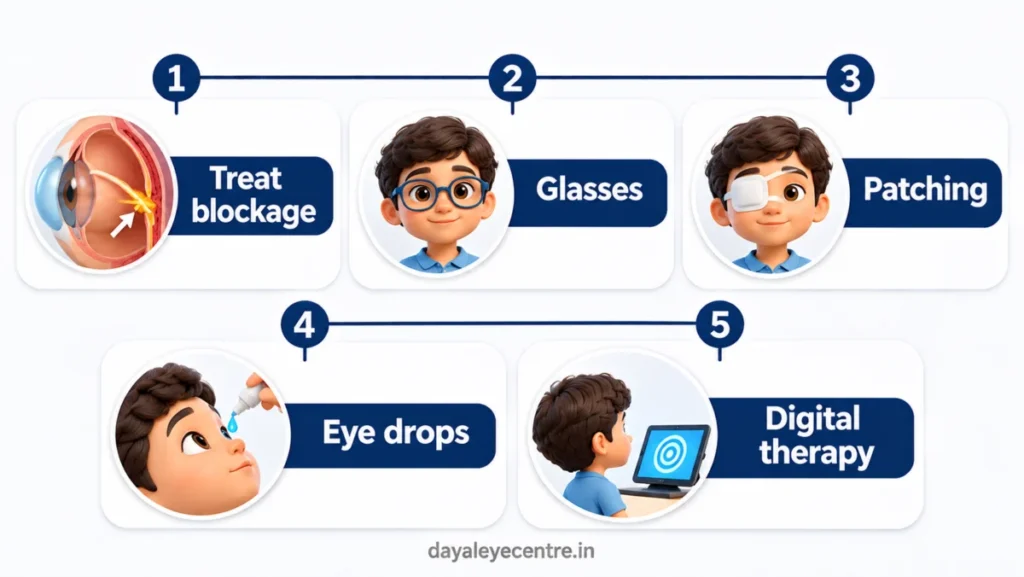
Treatment works by making the brain use the weaker eye. It usually follows these steps:
- Treat any blockage first, such as a cataract or a droopy eyelid.
- Glasses, worn full time, to give each eye a clear picture. Some children improve with glasses alone.
- Patching the stronger eye for a set number of hours a day, so the weaker eye has to work.
- Eye drops that blur the stronger eye, as an alternative to patching.
- Digital therapy, a newer option that shows each eye a slightly different picture.
A large study of 419 children under 7 found that blurring drops gave results comparable to patching, which helps families whose child will not keep a patch on. Health information on lazy eye also notes that children who will not fully recover should wear shatter-resistant glasses to protect the better eye.
If a squint remains after the vision has improved, squint correction treatment in Gurgaon may be discussed to straighten the eyes. Your doctor will plan the order with you.
Steady, daily treatment matters more than any single method.
Why age matters
The connections between the eyes and brain are still forming in early childhood, so treatment works best when it starts young. Children treated before the age of 5 typically recover near-normal vision, while treatment after 10 often restores only part of it.
Older children and teenagers can still benefit, but improvement tends to be smaller and slower. Depth perception may not fully recover even when sharpness improves.
The earlier lazy eye is found, the more the eye can catch up.
When to book an eye check
Every child should have a complete eye examination at least once between the ages of 3 and 5, even with no obvious problem. Book sooner if you notice any of the signs above, or if there is a family history of squint or lazy eye.
Seek in-person eye care straight away if your child has an eye injury, a sudden turn of one eye or sudden double vision. Call Dayal Eye Centre on +91 81786 39701 during opening hours, or go to the nearest hospital emergency department.
Our paediatric and squint specialist in Gurgaon team includes doctors who focus on children’s eye care.
Blurred vision or squinting at school can also be symptoms of refractive error that glasses correct.
A simple check between 3 and 5 is the best protection against a missed lazy eye.
This article is general information. An ophthalmologist needs to examine your child’s eyes to advise on their case.
Helping your child’s vision develop
Lazy eye happens when the brain learns to ignore one eye, and it responds best to treatment in early childhood. Glasses, patching or drops, used every day, give the weaker eye the practice it needs. If you have noticed any signs, book a child eye check at Dayal Eye Centre in Sector 15, Gurugram.
Frequently asked questions
Can lazy eye be corrected in adults?
Treatment is most effective in childhood. Some older children and adults improve, but usually less, and an eye doctor can explain what is realistic.
Is lazy eye the same as a squint?
No. A squint is a turned eye, while lazy eye is reduced vision. A squint is a common cause of lazy eye, but they can occur separately.
How many hours a day does my child need a patch?
It depends on the vision in each eye and your child’s age. Your doctor will set the hours and adjust them at follow-up visits.
Will my child need glasses for life?
Many children still need glasses for their focusing power. Your doctor will review this as your child grows.
Can screen time cause lazy eye?
Screen time does not cause lazy eye. It develops from a squint, unequal focusing or something blocking vision in early life.
Does lazy eye come back after treatment?
It can slip back in some children, especially if treatment stops suddenly. Regular follow-up visits help catch this early.
How do I help my child keep the patch on?
Make patching part of a routine, such as during a favourite activity. Praise and small rewards often help young children accept it.

Trained for around 12 years at AIIMS New Delhi, Dr. Digvijay Singh is a super-specialist in paediatric ophthalmology, squint, glaucoma and neuro-ophthalmology — with over 70 publications to his credit.