Age-related macular degeneration (AMD) affects the macula — the small central part of the retina responsible for sharp, straight-ahead vision. Because the macula does the detailed work of the eye, AMD makes tasks like reading, driving, recognising faces and seeing fine detail progressively harder.
An important point that reassures most patients: AMD affects central vision, not the whole visual field. It does not usually cause total blindness, because side (peripheral) vision is typically preserved. What is at stake is the clarity of the central vision you rely on every day — which is exactly why early, specialist-led care matters.
AMD becomes more common with age. Globally it is a leading cause of vision impairment in people over 50, and the number of people affected worldwide is projected to rise from about 196 million in 2020 to roughly 288 million by 2040 as populations age (Wong et al., The Lancet Global Health, 2014). In India, population studies have reported late-stage AMD in around 1.2% of people aged 60 and over, with overall AMD prevalence across Indian studies ranging from about 1.4% to 3.1% (Krishnan et al., Investigative Ophthalmology & Visual Science / INDEYE study, 2010). As Gurgaon’s older population grows, so does the need for accessible retina care close to home.
There are two main types of AMD, and telling them apart guides the entire treatment plan.
The most common form — roughly 8 or 9 in 10 people with AMD have the dry type. It develops slowly, as the macula gradually thins and small deposits called drusen build up. Early on there may be no symptoms at all; over time, central vision can become blurred. Dry AMD is managed and monitored rather than injected.
Less common but more urgent. Abnormal blood vessels grow beneath the retina and leak fluid or blood, which can cause rapid central-vision loss over days to weeks. Although wet AMD accounts for the minority of cases, it is responsible for about 90% of the severe vision loss caused by AMD (American Academy of Ophthalmology). The good news is that wet AMD is also the type that responds to modern injection treatment — which is why sudden changes in vision should be checked without delay.
Dry AMD can also convert to wet AMD, sometimes suddenly. That is why home monitoring and regular reviews are part of every AMD care plan at our centre.
Many people do not realise they have AMD until it starts affecting their sight, and early dry AMD often causes no symptoms. When symptoms do appear, the most common are:
Faces and print lose their sharpness while the edges of your vision stay clear.
A door frame, tiled floor or the lines of a book may appear distorted. This is an important warning sign of wet AMD.
It takes longer than it used to when moving from bright to dim surroundings.
Or a blurred or blank patch developing in the centre of your vision.
A sudden change in central vision — new distortion, a fresh blurred or dark central spot, or a quick drop in clarity — can signal wet AMD, where earlier treatment gives the best chance of protecting vision. If this happens, arrange an urgent retina evaluation rather than waiting for a routine appointment.
This is guidance, not a diagnosis — any new visual change should be assessed by an eye specialist.
A retina evaluation with an OCT scan picks up macular change before you notice it. Book one even if your vision feels normal.
Book an AMD evaluationEarly detection is one of the few things genuinely within our control with AMD, so an accurate diagnosis is the foundation of care. If you notice symptoms — or if you are over 50 and at higher risk — a retina specialist may recommend:
A standard eye exam measuring how clearly you see at different distances.
A simple grid of straight lines; if any appear wavy, broken or missing, it can point to macular change. It is also the tool you will use to monitor your own vision at home.
A specialised camera captures detailed images of the retina to document any changes and track them over time.
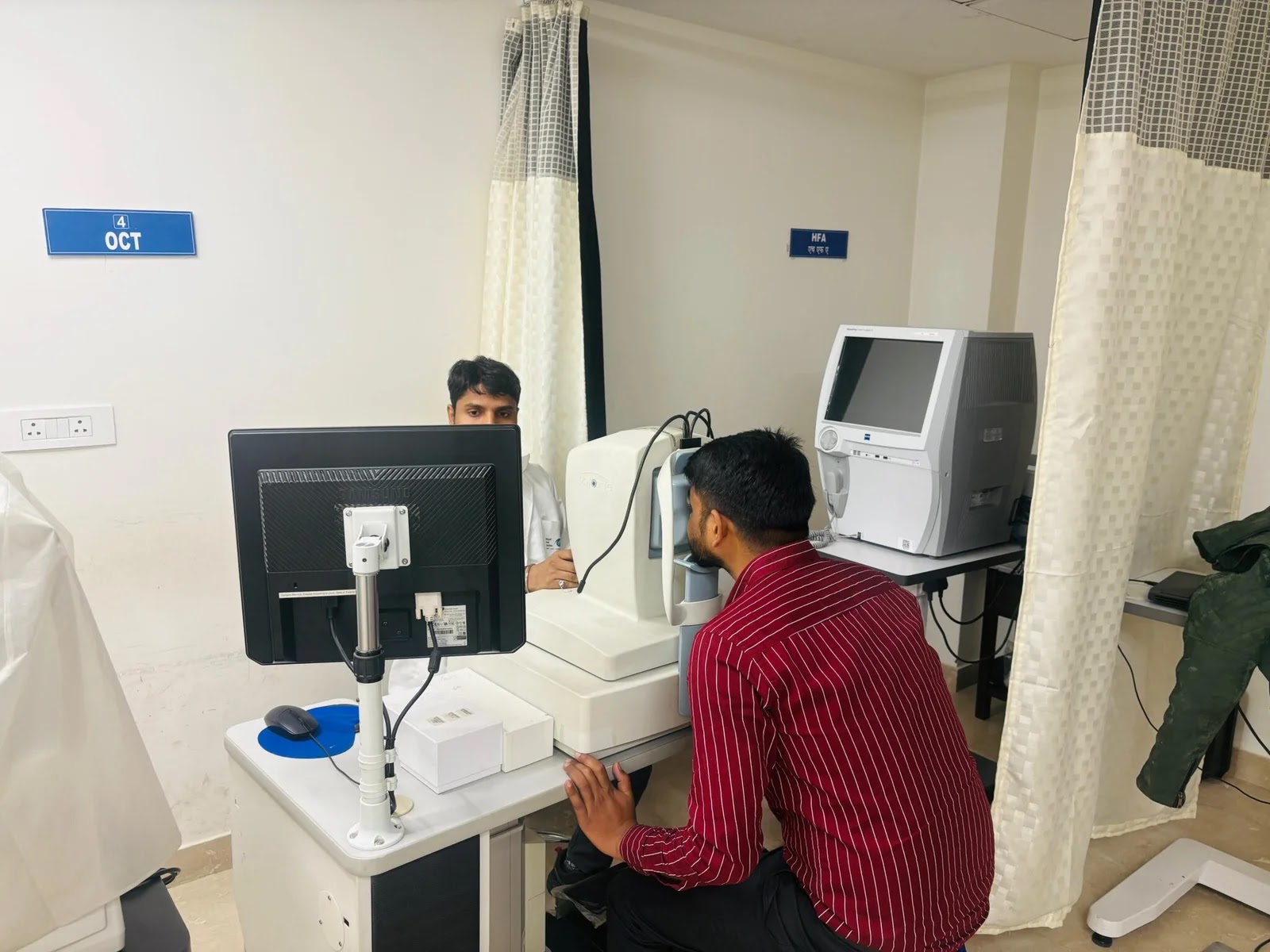
A quick, non-contact scan that produces highly detailed cross-sectional images of the macula. OCT is central to AMD care because it reveals fluid, swelling and structural change — especially in wet AMD — often before vision drops noticeably, and it guides when injections are needed and whether they are working. Where wet AMD is suspected, a fundus fluorescein angiography (FFA) may also be used to map the leaking vessels.
For comprehensive care of all retinal disorders, including AMD, see our Retina Treatment page.
Visual acuity, Amsler grid, fundus photography, OCT and FFA where needed — all in-house, so your plan is decided the same day.
Book an AMD evaluationAMD cannot currently be cured, and no treatment reverses vision that has already been lost. What treatment can do — and does well when started in time — is slow the disease and help preserve the vision you still have. The right plan depends on whether you have dry or wet AMD, which is why diagnosis comes first.
There is no injection for dry AMD. Care focuses on slowing progression and catching any conversion to wet AMD early.
For people with intermediate AMD, a specific combination of vitamin C, vitamin E, zinc, copper, lutein and zeaxanthin has been shown to reduce the risk of progressing to advanced AMD by about 25% (National Eye Institute, AREDS/AREDS2 studies). These supplements do not restore lost vision or prevent early AMD, and they are not right for everyone, so they should be taken on a doctor’s advice. You can learn more on our Eye Nutrition Treatment page.
Scheduled check-ups let your specialist track the macula over time, and home use of an Amsler grid helps you spot sudden changes between visits so they can be reported quickly.
Wet AMD is treated with anti-VEGF injections — medicines given into the eye that reduce the abnormal, leaking blood vessels beneath the retina, settling the swelling and helping to limit further vision loss. Commonly used agents include ranibizumab, aflibercept and brolucizumab (and their approved biosimilars). Injections are usually given on a schedule — often starting monthly and then spaced out based on how the macula responds on OCT, typically every 1–2 months at first.
Anti-VEGF therapy has changed the outlook for wet AMD. In published clinical experience, treatment stabilises vision in the large majority of patients — on the order of 9 in 10 — and improves vision in a meaningful minority when started early and continued consistently (American Academy of Ophthalmology; retina clinical literature). Results vary from person to person and depend heavily on how promptly treatment begins and how regularly it continues, which is why keeping to the injection and review schedule matters so much.
The injection is done after numbing the eye and is generally well tolerated — most patients describe a brief sensation of pressure rather than sharp pain. As with any procedure it carries small risks, which your specialist will explain during your consultation.
Managing AMD is ongoing rather than one-and-done. A consistent follow-up routine is what protects vision over the long term.
Regular eye exams. People with dry AMD are generally reviewed every 6–12 months; those with wet AMD usually need more frequent visits tied to their injection schedule.
Home monitoring. Using an Amsler grid at home helps detect sudden vision changes so they can be reported and assessed quickly.
Vision rehabilitation. If AMD is affecting daily activities, a low-vision assessment can provide practical tools — magnifiers, better task lighting and other aids — to help you keep reading, working and staying independent. Learn more on our Low Vision Treatment page.
Not smoking — the single most important change you can make for your macula.
Keeping blood pressure and cholesterol under control.
Eating a nutrient-rich diet with leafy greens.
Protecting your eyes from excessive sun exposure.
Some risk factors for AMD — age, family history and genetics — cannot be changed. Others are within your control, and the single most important modifiable one is smoking, which published research links to roughly a two-to-four-fold higher risk of AMD and faster progression (American Academy of Ophthalmology).
Alongside not smoking, managing blood pressure and cholesterol and protecting your eyes from excessive sun exposure all help.
The cost of AMD care depends on the type of AMD, its stage, the treatment needed and the anti-VEGF medicine chosen — dry AMD is generally managed with monitoring and supplements, while wet AMD involves injection therapy given over time. The figures below are indicative starting ranges for planning only; they are not a fixed quote, and your exact plan is confirmed after examination.
Comprehensive retina evaluation with a specialist.
The diagnostic scans your case needs — OCT, fundus photography and FFA where indicated.
A written treatment and follow-up plan, including the likely number of injection visits.
Counsellor support for insurance, TPA approvals and Easy EMI.
Whether you have dry or wet AMD, and the stage it has reached.
The anti-VEGF medicine chosen — originator or approved biosimilar.
The number of injections and review scans needed over time.
Whether one eye or both eyes are being treated.
Because wet AMD is treated with a series of injections rather than a single procedure, your specialist will explain the likely number of visits for your situation so there are no surprises.
Easy EMI is available (via Savein), along with cashless insurance/TPA facilities and support for the schemes below where applicable. Insurance coverage for AMD injections varies by policy — our team will help you check yours.
Prices are indicative and subject to change; final cost is determined after a clinical consultation and depends on individual factors.
AMD care is a long-term relationship, so it helps to choose a centre built for consistent, specialist-led retina care.
NABH-accredited — eye hospital with 20+ years of service in Gurgaon.
Over 1.2 lakh eye surgeries performed — with a dedicated retina service — not a general clinic that occasionally sees retina patients.
Complete AMD pathway under one roof — OCT and FFA diagnostics, anti-VEGF injection therapy for wet AMD, and structured monitoring and nutritional guidance for dry AMD.
Recognised care — Ayushman Bharat Awards (2021 and 2024, Dainik Jagran) and a Haryana surgical-centre excellence award (2025).
Accessible location — Sector 15 Part 2, just off the Delhi–Jaipur Highway (NH-48) — about 25 minutes from Delhi and easy to reach from across Gurgaon and NCR, which matters when treatment means regular visits.
MBBS, DNB (Gold Medalist)
A fellowship-trained vitreo-retinal surgeon with 8+ years of experience, she works across medical and surgical retina, with a keen interest in diabetic retinopathy and age-related macular degeneration.
View full profileThe questions patients and families ask us most about AMD. For anything specific to your eyes, a consultation gives the clearest answer.
Medically reviewed by Dr. Neelam Khatwani, Vitreo-Retinal Surgeon, Dayal Eye Centre · Last reviewed: 29 July 2026 · Editorial Policy