Nearsightedness affects nearly half of all Americans, with one in every four children inheriting this condition from their parents. When myopia becomes severe, patients face more than just thick glasses – they risk serious eye conditions like retinal detachment and glaucoma that can threaten their vision.
The natural lens in highly myopic eyes focuses images incorrectly, causing blurry distance vision that worsens over time. While glasses and contact lenses help temporarily, many patients seek permanent solutions to protect their long-term eye health and improve their quality of life.
Talk with your eye doctor about whether permanent treatment might be right for you. Modern surgical options like LASIK, implantable lenses, and refractive lens exchange have shown excellent results in treating severe nearsightedness. Your doctor can help determine which approach best suits your specific vision needs and eye health conditions.
This guide examines the proven surgical treatments available for high myopia. We’ll explore how each option works, review their success rates, and discuss what results you can realistically expect. Understanding these choices helps you make an informed decision about your vision correction journey.
Understanding High Myopia
Our natural lens is like a camera lens – crystal clear in most of us. But in high myopia, the eye grows unusually long, causing severe nearsightedness that affects millions worldwide. By 2050, predictions suggest nearly 938 million people will develop this condition. High myopia threatens more than just clear vision – it risks your long-term eye health.
What makes myopia ‘high’
Eye doctors classify myopia as ‘high’ when your prescription exceeds -5.00 to -6.00 diopters, or when your eye length stretches beyond 26-26.5mm. Think of it like a camera that’s too long – images focus in front of the retina instead of directly on it. This stretching changes multiple parts of your eye, including the outer wall (sclera), light-sensitive layer (retina), and main nerve (optic nerve).
The condition affects different populations differently. About 20% of young Chinese individuals develop high myopia, while only 2% of Caucasians experience it. China faces a particularly concerning trend, with more cases of extreme myopia (beyond -10.00 diopters) appearing recently.
Risk factors and complications
Your chances of developing high myopia increase with certain factors. Genetics play a major role, especially in Asian and Middle Eastern populations. Some medical conditions also raise your risk:
- Congenital glaucoma
- Retinopathy of prematurity
- Marfan syndrome
- Ehlers-Danlos syndrome
Like any other condition in the body, untreated high myopia carries serious risks. About 70% of patients develop sight-threatening retinal problems. The complications include:
Glaucoma: Your risk increases by 50% compared to mild myopia cases
Cataract Formation: You’re 17% more likely to need cataract surgery than those with moderate myopia
Retinal Detachment: Most concerning, your risk becomes 5-6 times higher than those with mild myopia
Why permanent treatment matters
Talk with your eye doctor about permanent treatment options. Without proper care, high myopia significantly threatens your eye health. In some populations, it leads to monocular blindness through a condition called myopic maculopathy.
The financial impact proves substantial – myopic macular degeneration alone causes global productivity losses of INR 506.28 billion. These costs continue rising as myopia rates increase worldwide.
Timing matters greatly since high myopia often starts in childhood. Without treatment, vision may not stabilize until early adulthood. For those over 60, high myopia creates much higher risks of vision loss (87.63 times) compared to moderate myopia (5.54 times).
The Rotterdam Eye Study reveals concerning numbers for untreated cases: 39% developed myopic maculopathy, 17% experienced open-angle glaucoma, and 5% developed cataracts. These findings show why permanent treatment becomes crucial for protecting your vision and preventing irreversible damage.
Medical Tests Before Treatment
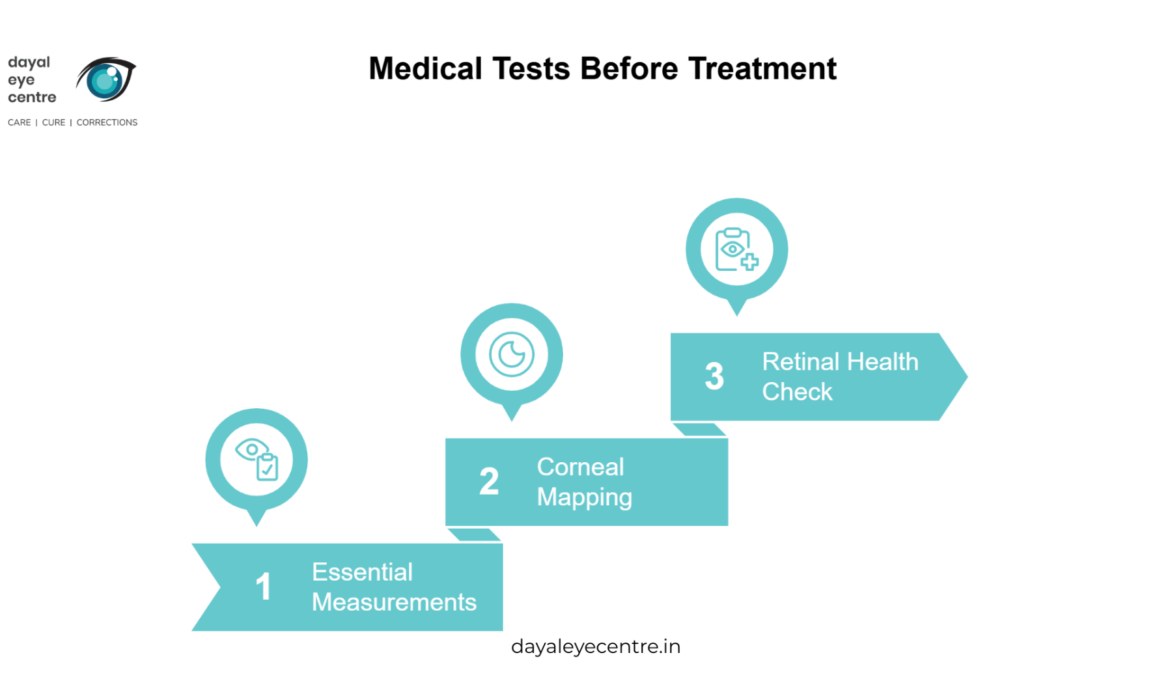
To determine whether surgery is right for you, your eye doctor will conduct several important tests. These tests help create a detailed picture of your eye health and structure, ensuring the safest and most effective treatment plan.
Essential eye measurements
Your eye examination starts with measuring your prescription through different methods. Like taking multiple photos of the same scene, each test provides a different view of your vision needs:
First, a computerized test gives initial readings. Then, after using drops to dilate your pupils, your doctor performs a detailed measurement to determine your exact prescription.
Your doctor will also check the pressure inside your eyes. Normal pressure ranges from 12 to 19 mm of Hg. Two main methods measure this pressure:
- The air puff test – quick and comfortable
- The traditional pressure test – considered most accurate
For patients with high myopia, measuring eye length becomes crucial. While a typical adult eye measures about 23.6mm, highly myopic eyes often stretch beyond 26.5mm. Your doctor might use:
- Sound waves to measure eye length
- Light-based measurement (especially helpful for children)
Corneal mapping
Think of corneal topography as creating a detailed map of your eye’s front surface. This advanced technology produces color-coded images showing the shape and curves of your cornea.
The test creates three important maps:
First, a curvature map uses warm colors (red and orange) for steeper areas and cool colors (green and blue) for flatter regions. A healthy cornea typically shows mostly green.
Second, an elevation map compares your cornea’s shape to an ideal model, helping identify any unusual areas.
Third, a thickness map measures how thick your cornea is across different areas. Most Indian patients have corneas about 530 microns thick. Measurements under 495 microns need special attention.
Retinal health check
Since high myopia increases your risk of retinal problems, your doctor will carefully examine the back of your eye. Using special drops to dilate your pupils, they look for:
Any weak areas or holes that might need treatment before surgery. The central vision area (macula) and main nerve (optic disk) receive special attention, as these areas often show changes in highly myopic eyes.
Your doctor may also use OCT imaging – think of it as taking a cross-section picture of your retina. This detailed scan helps identify any hidden problems that could affect your surgery outcome.
This thorough retinal check becomes especially important since 70% of people with high myopia develop serious retinal problems. Finding and treating any issues before surgery helps ensure the best possible results.
These detailed tests help your eye doctor recommend the most suitable treatment for your specific needs. Talk with your doctor about what each test shows and how it affects your treatment options.
Surgical Options for High Myopia
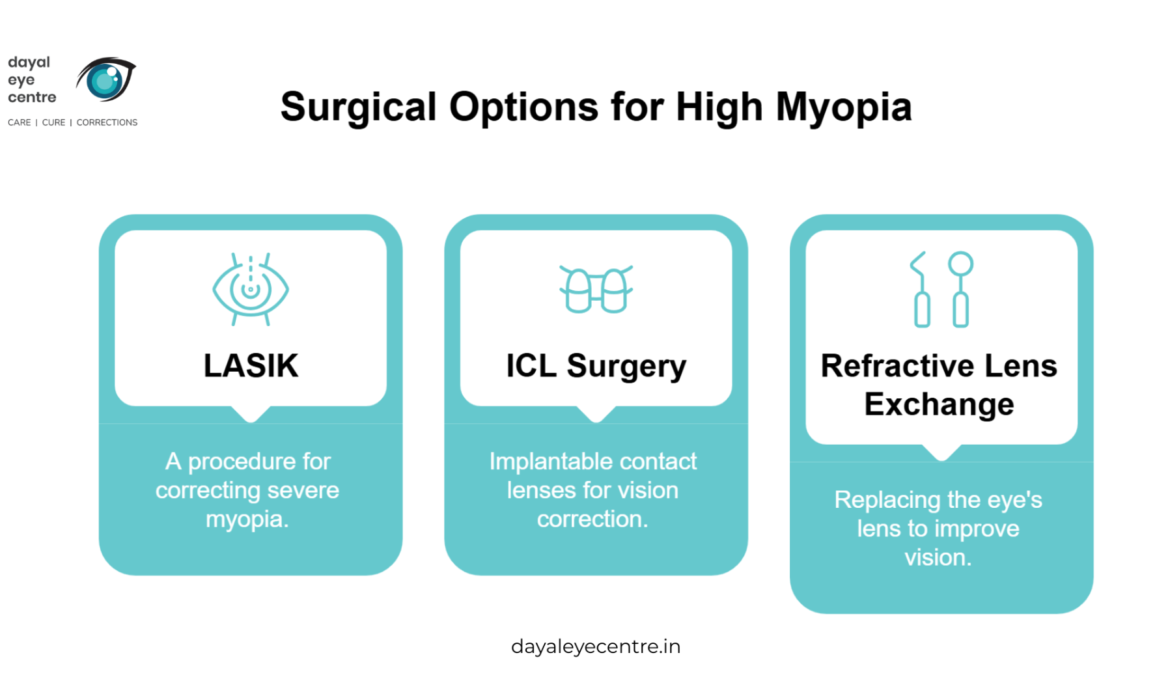
Modern surgical techniques offer several permanent solutions for high myopia. Like any other procedure in the body, each option has specific benefits and considerations based on your age, prescription, and overall eye health.
LASIK for severe cases
LASIK surgery can effectively treat myopia up to -10.00 to -12.00 diopters. Recent studies show promising outcomes even for very high prescriptions between -10.00 to -13.50 diopters, with 51% of patients achieving 20/20 vision and 81% reaching 20/25 vision. Patient satisfaction typically improves from 7.5 before surgery to 9.1 afterward.
However, LASIK carries certain risks for severe myopia cases:
- Corneal weakening risks in prescriptions above -12.00 diopters
- Night vision challenges
- Reduced contrast sensitivity in some cases
ICL surgery benefits
Implantable Collamer Lens (ICL) surgery has become a preferred choice for many patients with moderate to severe myopia. During this procedure, your eye surgeon places a special lens between your iris and natural lens. ICL can correct prescriptions from -3.00 to -20.00 diopters.
Clinical studies show excellent results, particularly in younger patients with severe myopia and lazy eye. The procedure offers several benefits:
- Sharper vision quality
- Better night vision
- Less dry eye problems
- Protection from UV rays
- Option to remove if needed
These days with newer lens designs like the V4c model with a central hole, ICL surgery has become even safer. Patient satisfaction reaches 99%, making it increasingly popular among eye surgeons and patients.
Refractive lens exchange
For patients over 45-50 years with high myopia beyond 6 diopters, refractive lens exchange (RLE) presents another option. Think of it like early cataract surgery – your surgeon replaces your natural lens with an artificial one that corrects your vision.
About 80% of patients achieve freedom from glasses after RLE. The procedure offers unique advantages:
- Prevents future cataract surgery needs
- Corrects both distance and reading vision with special lenses
- Helps patients unsuitable for corneal procedures
However, like any other procedure in the body, RLE carries some risks. High myopia patients face increased chances of retinal detachment. Your eye doctor will carefully examine your retina before recommending this option.
The choice between these surgeries depends on several factors. ICL works well for patients under 50, while RLE might better suit older individuals showing early lens clouding. Most surgeons recommend ICL for prescriptions between -3.00 and -20.00 diopters in younger patients, using RLE more cautiously in older individuals due to retinal detachment risks.
Recovery and Results
After cataract surgery, you’ll have some discomfort, mild redness or foreign body sensation for a few days. Healing generally occurs within a few days to weeks. Understanding what to expect helps prepare you for your vision improvement journey.
Immediate post-surgery care
Post-surgical care helps ensure the best possible outcomes. Like any other procedure in body, you might feel mild burning, itching, or grittiness in your eyes. Your eye doctor will prescribe:
- Pain medication and eye drops for comfort
- Protective shields to wear while sleeping
- Artificial tears to keep eyes moist
Though vision appears blurry right after surgery, many patients notice improvements within hours. Most can drive within 24-48 hours after the procedure.
To protect your eyes during early recovery:
- Don’t rub your eyes or apply pressure
- Avoid swimming pools and hot tubs for at least one week
- Skip eye makeup for 36 hours after surgery
- Wear sunglasses to protect from bright light
Vision stabilization timeline
We can have a normal diet from the day of surgery, but vision takes time to fully stabilize. About 90% of patients see significant improvements within days. However, complete healing requires patience.
Talk with your eye doctor about vision changes during recovery. Full stabilization typically takes three to six months. During this time, you might experience:
- Dry eye symptoms that improve over six months
- Temporary glare or halos around lights
- Some light sensitivity
- Vision that varies slightly
Your follow-up schedule typically includes:
- First check within 24-48 hours
- Regular visits over six months
- Additional visits as needed
Clinical studies show promising results. About 84.3% of patients achieve their target prescription within ±0.50 D after six months. Distance vision without glasses improves dramatically, with 94% success rates.
Long-term results remain stable, with vision measurements showing significant improvements at six months, one year, and two years compared to before surgery. Remarkably, 98% of patients maintain or improve their best vision three months after surgery.
For the best recovery:
- Take breaks from computer work
- Use your eye drops as prescribed
- Keep all follow-up appointments
- Tell your doctor about unusual symptoms
Long-term Success Rates
Like a camera lens that stays clear for years, permanent treatments for high myopia show excellent long-term results. Our surgical techniques and technology continue improving, leading to better outcomes and higher patient satisfaction over time.
5-year outcomes
Five-year studies show remarkable success across different treatments. For SMILE procedures, 73% of patients achieve perfect 20/20 vision or better, while 82% reach their target prescription within half a diopter. The procedure proves both safe and effective, with safety scores staying steady at 1.19±0.12.
ICL surgery shows equally promising results after five years. Patients with both high and extremely high myopia maintain good safety levels, measuring 1.03±0.10 and 1.32±0.39 respectively. About 60% of high myopia patients achieve their exact target prescription.
Your vision stays remarkably stable during these five years:
- After SMILE, changes remain minimal from three months (0.11±0.44D) to five years (-0.15±0.46D)
- ICL patients see small shifts from one month (-0.69±0.97D) to five years (-1.74±1.19D)
10-year stability data
Ten-year studies confirm these treatments last. LASIK results show 71% of eyes maintain correction within one diopter, while 92% stay within two diopters. Vision typically changes by only -0.12±0.16 diopters each year.
Talk with your eye doctor about long-term stability. After ten years, 40% of patients maintain clear vision of 20/40 or better without glasses. Even better, 54.6% of eyes see more clearly with glasses than they did before surgery.
Some patients need touch-up procedures – about 27.5% over ten years, usually for slight undercorrection. Serious complications like corneal weakening remain rare, affecting only 1% of eyes with very high corrections above 15 diopters.
Patient satisfaction studies
Patient satisfaction remains consistently high after these procedures. LASIK satisfaction ranges from 82% to 98%, with 98.5% of patients achieving their main vision goals.
These treatments significantly improve quality of life:
- 93% report better daily life after surgery
- 97.5% would recommend the procedure to friends
- 91.2% feel satisfied with their results
Detailed surveys show strong satisfaction scores – averaging 2.64 out of 3 points. In a large study of 5,526 patients, overall satisfaction reached 52.03%.
These results keep improving. Satisfaction increased from 93% in 1997 to 100% in 2020, reflecting better technology and surgical techniques. Most patients see better than before – 75% gain one line on the vision chart, while 2% improve by two lines.
The connection between satisfaction and continued eye care shows these treatments work well. Another study of 2,671 patients found 93.86% satisfaction, confirming how these procedures positively impact patients’ lives.
Managing Expectations
Talk with your eye doctor about what results you can realistically expect from high myopia treatment. While these procedures can dramatically improve your vision, outcomes vary for each person.
Realistic vision goals
Clinical studies show that severe myopia patients often achieve greater than expected line gains in vision after surgery. This happens because the new lens sits closer to your retina’s center, making images appear clearer and larger.
Patients receiving implantable collamer lenses (ICLs) with stronger prescriptions often see the most dramatic improvements. All vision correction surgeries help by making images focus more naturally on your retina.
For cataract-related procedures, about 62% of myopic eyes show some retinal changes. Your eye doctor will discuss:
- What distance vision you can expect
- How near vision might change
- Whether you might need reading glasses
- How vision might differ between eyes during recovery
Interestingly, even patients with both high myopia and lazy eye often see significant improvements after surgery. Studies suggest factors beyond just image magnification contribute to these positive results.
Possible limitations
Like any other procedure in the body, vision correction has certain limitations. Several factors affect your results:
First, older age and longer eye length can limit vision improvement. This means older patients might see different results than younger ones having the same procedure.
Second, very high prescriptions create special challenges, including:
- Difficulty measuring eye length accurately
- Bulging at the back of the eye
- Problems with central vision
If you couldn’t wear contact lenses comfortably before, you might have noticed night vision problems. However, these patients often feel especially satisfied after surgery because any improvement feels significant.
For laser vision correction beyond -10.00 diopters, your doctor will carefully discuss potential risks, including:
- Corneal wrinkles
- Corneal weakening
- Future cataract development
- Retinal detachment chances
Some limitations remain even after successful treatment. You might need glasses for night driving. However, if you’re over 40, keeping slight nearsightedness can actually help with reading vision.
The main goal remains achieving good vision quality. Sometimes, especially with very high prescriptions, aiming for improved vision with occasional glasses use gives better long-term results than trying to eliminate glasses completely. This approach helps ensure you’re satisfied with your outcome while maintaining realistic expectations.
Conclusion
Concerned about treating your high myopia? Talk with your eye doctor about your options. While treatments like LASIK, ICL, and lens replacement might seem complex at first, their long track record shows excellent results for severe nearsightedness.
The way smudgy lenses cause blurring of vision, untreated high myopia can threaten your long-term eye health. Clinical studies confirm these treatments work well – most patients maintain better vision even after 10 years, with satisfaction rates above 90%.
Like any other procedure in the body, success depends on proper screening and realistic expectations. Your eye doctor will help determine which treatment suits your specific needs. Book an appointment with Daya Eye Center to learn more about your options for clearer vision.
Remember, while these treatments need careful consideration and patience during recovery, they can free you from thick glasses and help protect against serious eye complications. Taking time to understand your options today helps safeguard your vision for years to come.
FAQs
1. Is there a permanent cure for high myopia?
While there’s no absolute cure, several permanent treatments can significantly improve vision for those with high myopia. Options like LASIK, Implantable Collamer Lens (ICL) surgery, and Refractive Lens Exchange (RLE) can provide long-lasting vision correction, reducing or eliminating dependence on glasses or contact lenses.
2. What is considered the most effective treatment for severe nearsightedness?
The most effective treatment varies depending on individual factors. For many with high myopia, ICL surgery has emerged as a preferred solution, offering correction for prescriptions up to -20.00 diopters. LASIK can be effective for some cases up to -12.00 diopters, while RLE is often recommended for patients over 45-50 years old with high myopia exceeding 6 diopters.
3. How long does it take for vision to stabilize after myopia treatment?
Vision typically improves significantly within the first few days after treatment. However, complete stabilization generally takes between three to six months. During this period, patients may experience some fluctuations in vision quality. Most achieve stable vision within this timeframe, with many reporting dramatic improvements in distance vision without spectacles.
4. What are the long-term success rates for high myopia treatments?
Long-term success rates for high myopia treatments are impressive. Ten-year studies show that 71% of LASIK patients maintain correction within ±1.00 diopters. For ICL surgeries, five-year data indicates high safety indices and good precision in achieving target corrections. Patient satisfaction rates consistently exceed 90% across various treatment options.
5. Are there any limitations to permanent myopia treatments?
While permanent treatments offer significant benefits, there are some limitations. Factors like age and axial length can affect outcomes. Some patients might still need glasses for specific tasks like night driving. Additionally, those with very high prescriptions (beyond -10.00 diopters) may face higher risks of complications. It’s crucial to have realistic expectations and discuss potential limitations with an eye care specialist before choosing a treatment option.