Cataract surgery has come a long way from its early days as a simple lens removal procedure. Today, eye surgeons use sophisticated tools and techniques to not just remove cataracts, but also improve overall vision quality. Much like how modern cameras offer precise focusing and clarity, these new surgical methods provide enhanced accuracy and better outcomes.
Among the latest advancements, Light Adjustable Lenses (LALs) stand out. Patients receiving these lenses are twice as likely to achieve 20/20 vision without glasses compared to traditional lens options. Surgeons now also use laser-guided systems and artificial intelligence to plan and perform surgeries with remarkable precision—similar to how GPS technology guides vehicles to their destination.
This guide highlights the technologies transforming cataract surgery, from advanced artificial lenses to computer-assisted surgical tools, showing how these improvements help doctors deliver the best results for their patients.
Understanding Modern Cataract Surgery
Our natural lens works like a camera lens, crystal clear in most of us. As we age, this lens can become cloudy, affecting millions of people worldwide. According to the American Academy of Ophthalmology, approximately 24.4 million Americans over 40 have cataracts, and this number may reach 45.6 million by 2050.
What causes cataracts
Similar to how smudges on a camera lens blur images, cataracts cause vision to become hazy over time. Proteins in the lens break down and clump together, forming cloudy areas that block light. Initially small, these spots grow, causing increasing blurriness. The lens may also develop a yellowish or brownish tint, altering color perception.
Factors that accelerate cataract formation include
- Diabetes and high blood sugar
- Previous eye injuries or surgeries
- Family history of cataracts
- Excessive UV exposure
- Long-term corticosteroid use
Lifestyle choices also play a role: smoking, excessive alcohol consumption, and prolonged sun exposure without eye protection can speed up cataract development.
Limitations of Traditional Surgery
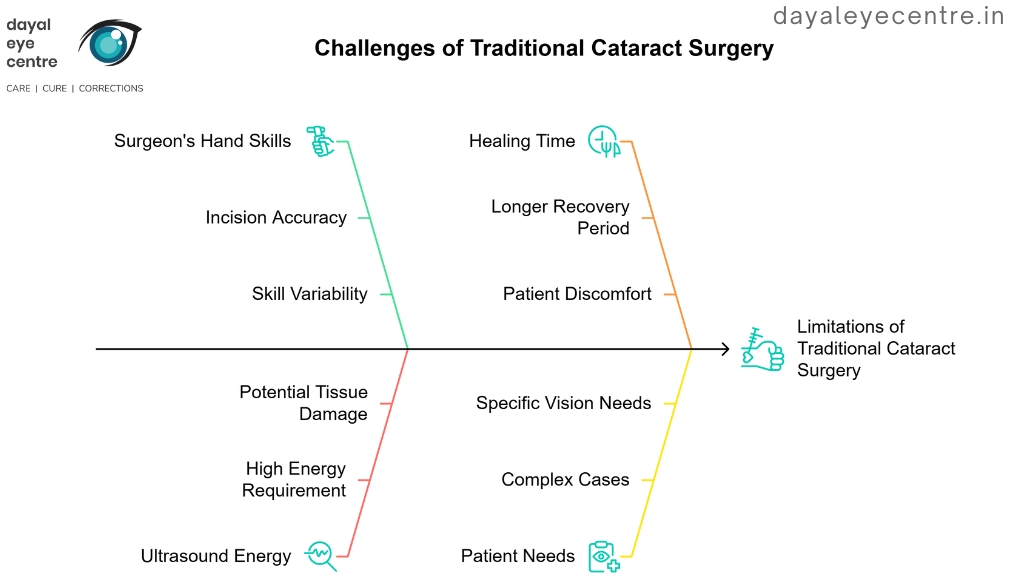
Traditional cataract surgery has helped millions, but it has limitations. Surgeons manually create incisions using specialized instruments and use ultrasound waves to break up and remove the cloudy lens.
Challenges of this approach include:
- Incision accuracy relies heavily on the surgeon’s hand skills
- More ultrasound energy may be needed to remove the cataract
- Longer healing time for patients
Even highly skilled surgeons face natural limits when operating by hand. Patients with complex cataracts or specific vision goals may not achieve the best results using traditional methods alone.
Why traditional surgery isn’t enough
Cataract surgery has served patients well for many years, but like any other procedure in the body, it has its limitations. Traditional surgery relies on the surgeon’s hands to make incisions with regular instruments. They use ultrasound waves through a special probe to break up and remove the cloudy lens.
Though this approach works, it presents several challenges:
- Incision accuracy depends heavily on hand skills
- More ultrasound energy needed to break the cataract
- Longer healing time for patients
Even the most skilled eye surgeons face natural limits when working by hand. Some patients, especially those with complex cases or specific vision needs, might not get the best possible results with traditional methods.
Laser-assisted cataract surgery changes this picture entirely. Think of it like having a precise GPS system for the eye – the laser creates detailed 3D maps, helping surgeons plan and perform procedures with remarkable accuracy.
Modern imaging systems, particularly Optical Coherence Tomography (OCT), show doctors exactly where cataracts are and how deep they go. This proves especially helpful for patients with astigmatism or advanced cataracts, where precise measurements make a big difference in outcomes.
Studies show laser-assisted procedures can make corneal openings up to ten times more accurate than traditional manual techniques. Patients often heal faster too, since the laser requires less ultrasound energy to remove the cataract.
Talk with your eye doctor about whether traditional or laser-assisted surgery is right for you. For many patients with standard cataracts, traditional surgery remains a good option. Your choice will depend on your specific eye condition, overall health, and vision goals.
Laser-Assisted Cataract Surgery: The Next Level
Laser-assisted cataract surgery changes the landscape. Think of it as having a precise GPS system for your eye. The laser creates detailed 3D maps, allowing surgeons to plan and execute procedures with exceptional accuracy.
Modern imaging, especially Optical Coherence Tomography (OCT), shows the exact size, location, and depth of cataracts. This is particularly valuable for patients with astigmatism or advanced cataracts, where precision makes a significant difference in outcomes.
Research shows laser-assisted procedures can create corneal openings up to ten times more accurate than manual methods. Patients often experience faster healing since the laser requires less ultrasound energy to remove the lens.
Choosing the Right Approach
Discuss with your eye doctor whether traditional or laser-assisted surgery suits your needs. Traditional surgery may still be appropriate for patients with standard cataracts, while laser-assisted techniques provide additional precision for complex cases or those seeking premium vision outcomes. Your choice should consider your specific eye condition, overall health, and personal vision goals.
Latest Technology for Cataract Surgery
Just as digital cameras revolutionized photography, new technologies have transformed cataract surgery, making procedures more precise and patient recovery smoother. These innovations allow surgeons to achieve better visual outcomes while minimizing complications.
Laser-Assisted Techniques
Femtosecond Laser-Assisted Cataract Surgery (FLACS) functions like a digital precision tool for the eye surgeon. Imagine the difference between drawing a circle freehand versus using computer software to create a perfect one—the laser brings the same precision to surgery.
With FLACS, the laser:
- Creates exact incisimmons
- Opens the lens capsule precisely
- Breaks up the cataract into tiny pieces
This reduces the need for manual work and allows surgeons to use less ultrasound energy, making the procedure gentler on the eye.
Benefits for challenging cataracts:
- White cataracts can be safely treated with precise openings
- Posterior polar cataracts can be identified and managed early using built-in imaging
- Laser-created incisions often heal faster and reduce the risk of complications
FLACS gives surgeons more control and improves outcomes, especially in complex cases.
Advanced imaging systems
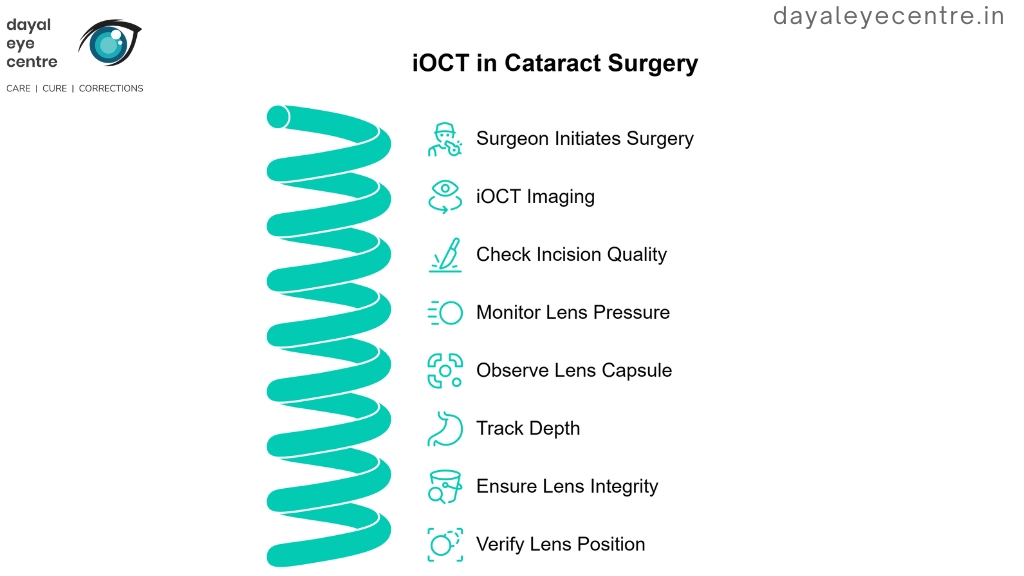
Modern cataract surgery also relies on cutting-edge imaging technology. Intraoperative Optical Coherence Tomography (iOCT) works like a GPS system for your surgeon, providing real-time insight inside the eye.
iOCT allows surgeons to:
- Assess incision quality instantly
- Monitor lens capsule behavior during surgery
- Track surgical depth precisely
- Ensure the back of the lens remains intact
- Verify proper positioning of the new intraocular lens
The FusionOptics system enhances visibility in complex situations, even when the cornea is cloudy. Surgeons can spot and address potential problems immediately, improving both safety and outcomes.
These technologies, combined with skilled surgical technique, make modern cataract surgery more predictable, safer, and faster in recovery than ever before. Patients benefit from sharper vision, fewer complications, and a smoother healing process.
Artificial intelligence in surgery
Artificial intelligence (AI) is transforming the way cataract surgery is planned and performed. From preoperative planning to post-surgery monitoring, AI supports eye surgeons at every step.
Before surgery:
- Recommends the best intraocular lens (IOL) for your eyes
- Suggests the optimal surgical approach based on your anatomy and vision needs
During surgery:
- Provides real-time feedback on incision size and lens positioning
- Monitors critical surgical steps for safety
- Guides instruments with sound or visual cues
- Detects subtle changes that might indicate complications
After surgery:
- Tracks your healing progress
- Helps predict potential complications
- Assists in training new surgeons through virtual simulations
Modern AI systems integrate data from multiple sources:
- Surgical sensors
- Video recordings
- Voice recognition systems
- Virtual reality modules
- Patient health records
While AI offers tremendous benefits, ongoing research aims to improve imaging data and performance metrics to make surgical guidance even more reliable.
New Treatments for Cataracts
Cataract treatment has advanced significantly, combining precision, speed, and safety. Two major innovations are femtosecond laser-assisted surgery and enhanced ultrasound techniques.
Femtosecond laser technology
Femtosecond lasers act like ultra-precise tools, delivering pulses as fast as 10^-15 seconds. They work in three stages: plasma formation, shockwave generation, and bubble creation, while sparing surrounding tissues.
Benefits of FLACS:
Corrects astigmatism with accurate arc-shaped cuts
Creates exact corneal incisions with unmatched precision
Forms perfect circular openings in the lens capsule
Breaks up cataracts with minimal energy
Proven outcomes:
- Reduces ultrasound energy requirements by 33–70%
- Decreases phacoemulsification time by 51% in controlled studies
- Lowers scattered energy in the eye by 39%, reducing stress and inflammation
Enhanced ultrasound methods
Modern torsional ultrasound systems, such as the OZil Torsional system, rotate side-to-side at high frequencies (32 kHz) instead of the back-and-forth motion of traditional ultrasound.
Advantages of torsional ultrasound:
- Prevents lens material from moving away during surgery
- Uses less energy to remove the cataract
- Minimizes heat damage at incision points
Additional advancements:
Phacoaspiration with optimized suction and lower energy reduces invasiveness and shortens surgery time
Micropulse and burst ultrasound modes improve precision
Venturi pump systems offer faster, more efficient removal compared to older peristaltic pumps
Advanced Lens Options
Modern cataract surgery isn’t just about removing the cloudy lens—it’s about restoring vision tailored to each patient. Advanced artificial lenses provide options for:
- Clear distance and near vision
- Correcting astigmatism
- Reducing dependence on glasses
- Enhancing color perception and contrast
Just like choosing eyeglasses for your unique vision needs, your surgeon selects the ideal lens based on your lifestyle, eye anatomy, and visual goals.
This combination of AI-guided planning, laser precision, advanced ultrasound, and customized lens technology ensures cataract surgery today is safer, faster, and more effective than ever before.
Premium intraocular lenses
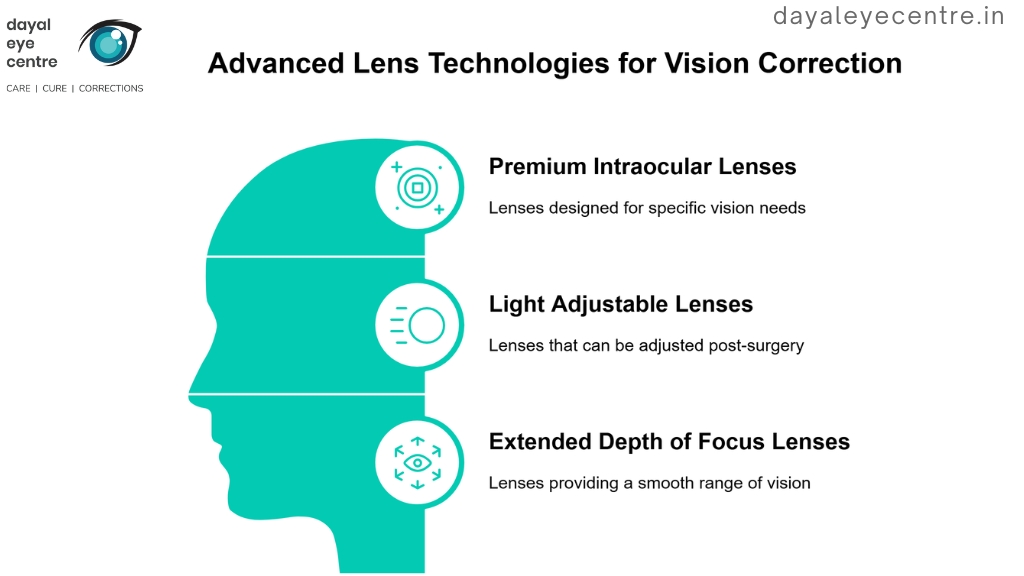
Premium artificial lenses use advanced materials and designs to meet each patient’s unique vision needs. Unlike standard lenses, these options can help you see clearly at multiple distances, often reducing or eliminating the need for glasses.
Types of Premium Lenses:
- Multifocal lenses: Provide zones for near, intermediate, and far vision
- Toric lenses: Correct astigmatism for sharper vision
- Accommodative lenses: Flex with your eye muscles to improve focus
Clinical Results:
- Over 70% of patients with toric lenses no longer need glasses
Patients receiving multifocal toric lenses achieve good distance vision without correction in 92–97% of cases
Light adjustable lenses
The Light Adjustable Lens (LAL) represents a major innovation in cataract surgery. Think of it like a camera lens you can fine-tune after the picture is taken.
Why LAL is unique:
- It can be adjusted after surgery using UV light treatments
- Provides vision correction comparable to LASIK
- Corrects small astigmatism (as little as 0.50 D)
Adjustment Process:
- Implant the lens during surgery
- Assess your vision after initial healing
- Fine-tune the lens using UV light treatments
- Lock in the final correction
Results:
- Most patients require 2–4 light treatments, each around 90 seconds
- 92% achieve their target vision within 0.50 D
- Patients are twice as likely to see 20/20 without glasses six months post-surgery
Extended depth of focus(EDOF)lenses
EDOF lenses provide a continuous range of vision, unlike traditional multifocal lenses that create distinct focal points.
Types of EDOF Lenses:
- Pinhole-effect lenses
- Lenses with light-bending patterns
- Enhanced single-focus lenses with modified centers
Notable Example: TECNIS Symfony IOL (FDA approved 2016)
- Improves intermediate vision
- Maintains clear distance vision
- Reduces halos, glare, and color distortion
Advantages:
- Better contrast sensitivity than traditional trifocal lenses
- Smooth, continuous vision from near to far
- Hybrid designs combine multiple optical features for superior visual performance
Choosing the Best Lens for You
Selecting the right cataract surgery and lens depends on:
- Your vision goals (reading, driving, computer work)
- Lifestyle needs and daily activities
- Your eye anatomy and prescription
- Doctor’s recommendation based on clinical assessment and advanced imaging
Modern cataract surgery offers tailored solutions for sharper, more comfortable vision. Talk with your eye doctor to explore premium lens options and find the approach best suited for your eyes.
Evaluating Your Needs
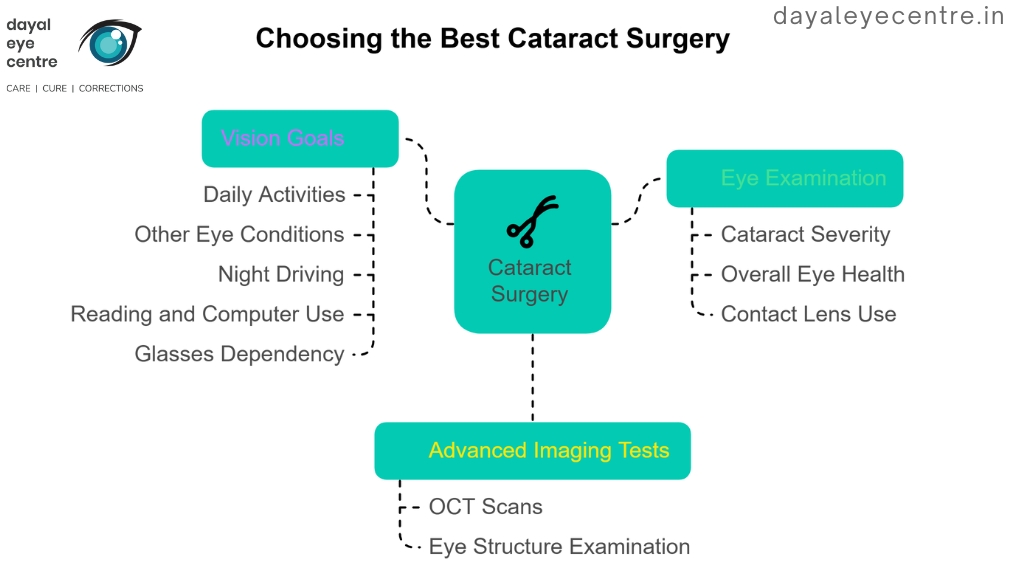
Your cataract surgery journey begins with a comprehensive eye examination to assess the severity of your cataract and overall eye health.
Contact Lens Notice:
- Soft lenses: Stop wearing 1–2 weeks before evaluation
- Hard or rigid lenses: Stop wearing for longer periods This ensures accurate measurements for surgical planning.
During your evaluation, your doctor will review:
- How your vision affects daily activities
- Other eye conditions such as glaucoma or retinopathy
- Night driving challenges and glare sensitivity
- Time spent on reading or computer use
- Desire to reduce dependence on glasses
Advanced imaging tests, including OCT scans, allow your doctor to examine critical eye structures. These tests help determine if standard surgery is sufficient or if advanced techniques are needed.
Comparing treatment options
Comparing Treatment Options
1. Phacoemulsification
- Small incisions for faster healing and reduced discomfor
- Most common modern cataract surgery
2. Small Incision Cataract Surgery (SICS)
- Self-sealing 6–7 mm incision
- Less disruption to eye tissues
- Lower post-operative discomfort
- Quicker recovery than traditional surgery
3. Extracapsular Cataract Extraction (ECCE)
- Recommended for very dense cataracts
- Larger 9–12 mm incisions
- Used when phacoemulsification is not feasible
4. Laser-Assisted Surgery
- Uses 3D imaging for precise corneal incisions
- Especially helpful for patients with astigmatism
- Minimally invasive, enhances accuracy and safety
Understanding costs and coverage
Typical Cataract Surgery Costs in India:
- Basic procedures: ₹15,000 – ₹1,00,000 per eye
- Advanced bladeless laser surgery: ₹80,000 – ₹1,20,000 per eye
Lens Options and Extra Costs:
- Basic monofocal lenses – often covered by insurance
- Toric lenses – ₹22,000 – ₹60,000 per eye
- Multifocal or premium lenses – ₹80,000 – ₹1,00,000 per eye
Additional Costs:
- Eye drops and medications
- Follow-up visits
- Possible management of minor complications
Insurance Tips:
- Most plans cover basic cataract surgery after 1–2 years
- Premium lenses may require additional payment
- Confirm coverage for daycare treatment, after-surgery care, and limits on reimbursement
- Ask about payment plans to manage out-of-pocket expenses
Modern cataract surgery has a success rate of over 95%, but choosing the best approach depends on your specific eye condition, vision goals, and budget.eeting with your eye doctor remains essential to choose the best approach based on your eye condition, vision needs, and budget.
Recovery and Expected Results
After surgery, your vision will improve gradually, similar to how a camera slowly comes into focus. Knowing what to expect can help you recover smoothly.
Immediately after surgery:
- You will wear a protective eye pad and shield, usually removed the next day
- Most patients go home within 15–30 minutes
Common temporary side effects:
- Mild discomfort, like having something in your eye
- Redness or bloodshot appearance
- Watery eyes
- Slightly blurred or double vision
Following your doctor’s instructions is crucial for proper healing and optimal visual outcomes.
Many patients notice colors appear brighter after surgery. This happens because cataracts often add a yellow or brown tint that dulls colors. You might especially notice improved blue colors, helping you see details you’ve been missing.
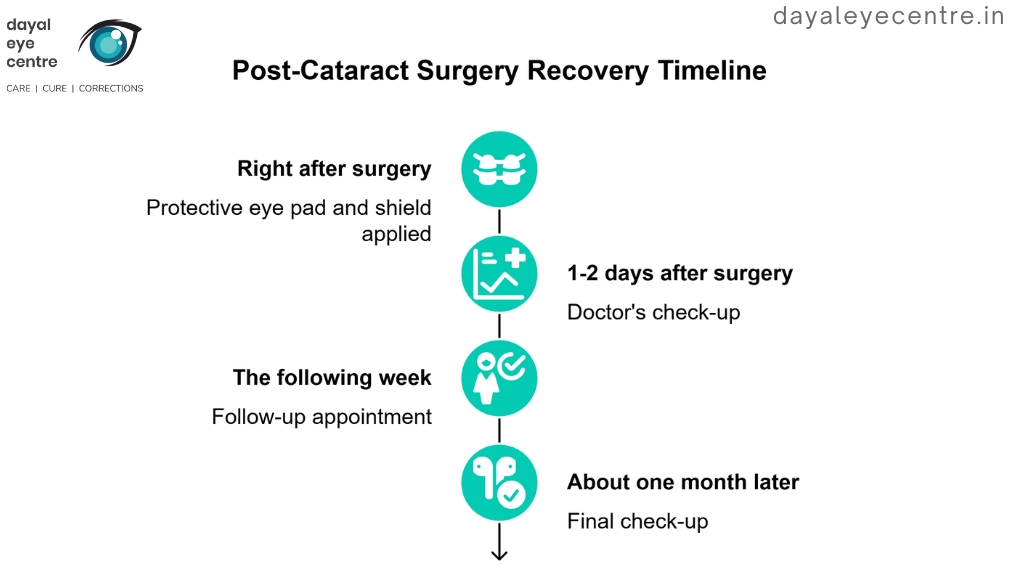
Your doctor will want to see you regularly to check your healing:
- 1–2 days after surgery
- The following week
- About one month later
What to expect after surgery
Right after surgery, you’ll wear a protective eye pad and shield, which your doctor removes the next day. Most patients go home within 15-30 minutes after the procedure. Like any other procedure in body, you might experience some common side effects:
- Mild discomfort, like having something in your eye
- Temporary redness or bloodshot appearance
- Watery eyes
- Slightly blurred or double vision
To deal with symptoms after surgery, try to avoid rubbing your eyes and keep them clean to prevent infection. Your eye doctor will prescribe eye drops to reduce inflammation and protect against infection. Following your medication schedule is crucial for proper healing.
Many patients notice colors appear brighter after surgery. This happens because cataracts often add a yellow or brown tint that dulls colors. You might especially notice improved blue colors, helping you see details you’ve been missing.
Your doctor will want to see you regularly to check your healing:
- 1-2 days after surgery
- The following week
- About one month later
Vision improvement timeline
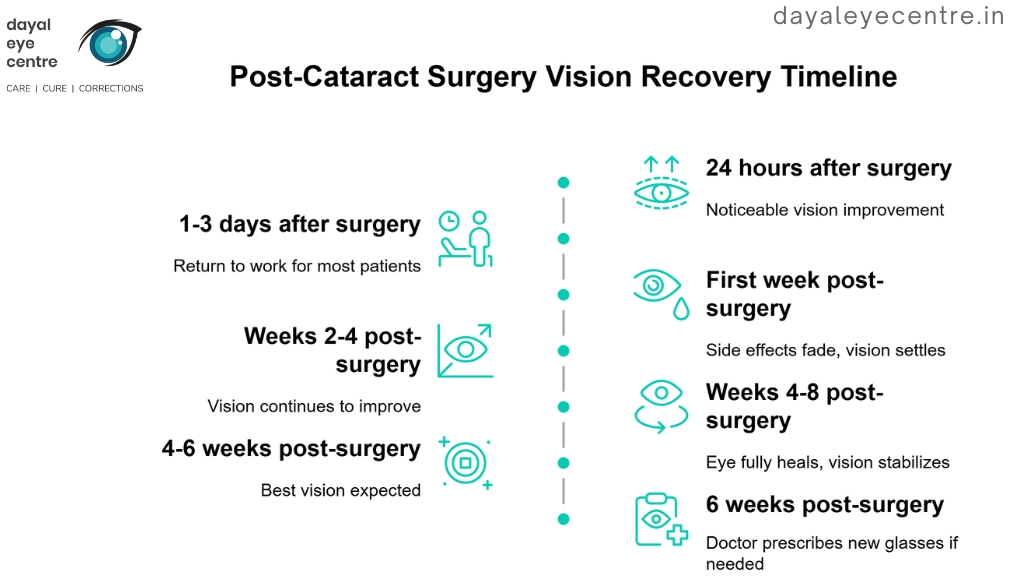
Just as a morning fog gradually clears, your vision typically improves in stages. Many patients notice better vision within 24 hours after surgery. Vision continues getting clearer over several days, and most people can return to work within 1-3 days.
Here’s what usually happens:
First Week:
- Side effects start to fade
- Vision begins to settle
- You can start basic activities
Weeks 2-4:
- Vision keeps improving
- Less need for eye protection
- Gradually return to normal activities
Weeks 4-8:
- Eye fully heals
- Vision becomes stable
- Check if you need glasses
Most people need about four weeks for full recovery. During this time, your vision might change slightly from day to day. Expect your best vision around 4-6 weeks after surgery.
If you need new glasses, your doctor will usually wait about six weeks after surgery to prescribe them. Many patients can drive without glasses once fully healed, though glasses might improve vision by another 5-10%.
Your healing depends on several factors:
- Your overall health
- How quickly you normally heal
- Type of surgery performed
- Following your doctor’s instructions
Call your eye doctor right away if you notice:
- Sudden vision loss
- Ongoing eye pain
- New floaters or flashes of light
- Excessive redness
- Unusual swelling
Modern cataract surgery shows impressive success in improving vision. Following your post-operative care instructions and keeping follow-up appointments helps ensure the best possible outcome. Remember, everyone heals differently, so be patient with your recovery process.
Conclusion
Cataract surgery has evolved remarkably, much like how modern cameras offer precision and customization unimaginable years ago. Today’s advanced tools – femtosecond lasers, computer-guided systems, and premium artificial lenses – help eye doctors achieve exceptional results. Studies show laser procedures create corneal openings up to ten times more precise than traditional methods, while Light Adjustable Lenses double your chances of seeing 20/20 without glasses.
We see success rates above 95% with modern cataract treatments. Though full healing takes about four weeks, most patients notice clearer vision just 24 hours after surgery. New lens options like EDOF and toric lenses can address specific vision needs – many patients find they rarely need glasses afterward.
Talk with your eye doctor about whether surgery is right for you. Together, you can explore available options and choose the approach that best fits your vision goals and lifestyle. As these technologies continue to advance, we look forward to offering even more precise, personalized solutions to help restore clear vision and improve quality of life.
FAQs
1. What are the latest advancements in cataract surgery technology?
Recent advancements include femtosecond laser-assisted surgery, which offers more precise incisions, and artificial intelligence-guided systems that enhance surgical planning and execution. Additionally, advanced imaging technologies like intraoperative Optical Coherence Tomography (iOCT) provide real-time visualization during the procedure.
2. How do modern intraocular lenses (IOLs) improve vision after cataract surgery?
Modern IOLs, such as multifocal and toric lenses, can correct various vision issues including astigmatism and presbyopia. Extended Depth of Focus (EDOF) lenses provide clear vision at multiple distances, while Light Adjustable Lenses allow for post-surgical adjustments to optimize visual outcomes.
3. What is the recovery process like after modern cataract surgery?
Most patients notice significant vision improvement within 24 hours after surgery. Full recovery typically takes about four weeks, with vision continuing to improve and stabilize during this time. Many patients can resume normal activities within 1-3 days, though complete healing may take 4-8 weeks.
4. How successful is modern cataract surgery?
Modern cataract surgery has a success rate exceeding 95%. With advanced techniques like laser-assisted surgery, patients are up to ten times more likely to achieve accurate corneal openings compared to traditional methods. Some premium lenses can double the chances of achieving 20/20 vision without glasses.
5. What factors should be considered when choosing cataract surgery options?
Important factors include current vision issues, lifestyle requirements, existing eye conditions, and personal preferences regarding glasses dependency. Additionally, patients should consider the costs and insurance coverage for different surgical techniques and lens options, as premium procedures may require out-of-pocket expenses.